

Lake Tahoe is facing a new debate over how much visitors should pay to use some of the region’s most popular public recreation areas. The U.S. Forest Service is proposing new or increased recreation fees at roughly 40 destinations across the Lake Tahoe Basin Management Unit and Eldorado National Forest, including beaches, trailheads, campgrounds and wilderness permits. The proposals were released in late July and early August 2026, with public comments accepted through September 29, 2026.
The proposal arrives as recreation sites around the Tahoe Basin continue dealing with heavy visitor demand, crowded parking areas, infrastructure maintenance needs and the rising cost of operating public lands. For visitors, the proposed changes could turn several locations that are currently free into paid destinations, while some existing fees could increase substantially over the next five years.
At Kiva Beach, for example, the Forest Service is proposing a new $10 vehicle day-use fee in the first year, increasing to $15 by the fifth year. At the popular Eagle Falls Picnic Area and Trailhead, the current $5 fee could increase to $10 initially and eventually reach $15.
The debate is therefore larger than a simple question of whether a visitor should pay $10 to park.
It is becoming a question about how California and the federal government should manage increasingly popular public lands when demand grows faster than infrastructure and maintenance budgets.
Lake Tahoe’s Recreation Fee Proposal Targets High-Demand Sites
The proposed changes cover a broad collection of recreation sites rather than a single beach or trail.
The Lake Tahoe Basin Management Unit and Eldorado National Forest have identified locations where additional revenue could help pay for maintenance, visitor services and improvements. According to the Forest Service proposal, more than 40% of recreation sites on the Eldorado National Forest would still remain fee-free, meaning the plan would not create a universal charge for accessing national forest land.
The distinction matters because Lake Tahoe’s recreation system is much larger than its most recognizable beaches and trailheads.
Visitors can still reach many forest lands without paying a recreation fee, particularly when they access areas by foot. However, the proposed charges would affect specific developed recreation facilities and high-demand access points.
| Recreation Site | Current Fee | Proposed Year 1 | Proposed Year 5 |
|---|---|---|---|
| Kiva Beach | $0 | $10 | $15 |
| Taylor Creek Visitor Center | $0 | $10 | $15 |
| Eagle Falls Picnic Area & Trailhead | $5 | $10 | $15 |
| 64 Acres Riverside | $0 | $10 | — |
| Luther Pass Overflow Campground | $0 | $20 | — |
| Watson Lake Campground | $0 | $20 | — |
The proposal also includes changes affecting wilderness permits and camping facilities. These changes would make the financial impact more noticeable for visitors who spend several days in the region rather than making a single beach stop.
For travelers planning a Lake Tahoe trip, the key issue is no longer simply whether recreation is free. It is which specific site they plan to visit and how they arrive.
Kiva Beach Represents The Core Of The Debate
Kiva Beach provides one of the clearest examples of why the proposal has generated controversy.
Located on the south shore of Lake Tahoe along Highway 89, the Forest Service-managed recreation area sits between the Taylor Creek Visitor Center and Tallac Historic Site. The beach provides access to the lake, picnic facilities and restrooms and is already one of the recognizable recreation stops in the South Lake Tahoe area.
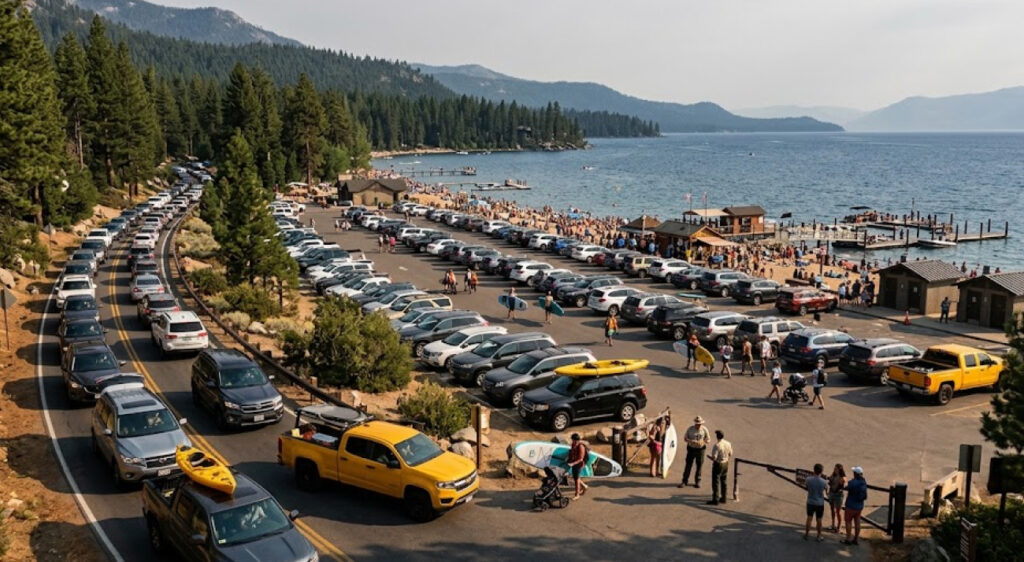
Under the proposal, a visitor arriving by vehicle would pay $10 during the first year, eventually rising to $15.
That could appear modest for a single vacation.
The economics change for residents and frequent visitors who use the beach repeatedly throughout the summer.
A family visiting once might spend $10 without changing its plans. A local household visiting twice a week could face hundreds of dollars in additional seasonal parking expenses. The same issue applies to photographers, anglers, paddlers, hikers and other recreation users who visit Tahoe frequently rather than treating the lake as a once-a-year destination.
That difference between tourist use and repeated local use is one of the most important aspects of the debate.
It also explains why some residents and recreation organizations are questioning whether fees are the most appropriate way to address overcrowding.
The Forest Service Says More Revenue Is Needed
The Forest Service’s argument centers on the cost of maintaining heavily used public recreation infrastructure.
Restrooms require servicing. Parking areas need maintenance. Trails deteriorate under heavy use. Trash collection increases with visitor numbers. Signs, facilities, roads and visitor-management programs also require ongoing funding.
The agency says at least 80% of the money generated by the proposed fees would remain dedicated to site maintenance and improvements, according to reporting on the proposal.
That creates a direct connection between the fee and the condition of the recreation area.
The argument is straightforward: if visitors are generating the demand that increases operating costs, collecting a portion of that cost from visitors can provide a dedicated source of funding rather than relying entirely on federal appropriations.
The U.S. Forest Service already operates a broader recreation-fee system across national forests, where fees can support developed campgrounds, day-use areas, permits and other facilities. Visitors can review current federal recreation information through the U.S. Forest Service recreation fee system.
But the financial argument does not automatically resolve the access question.
Higher Fees Could Change Who Uses Tahoe’s Public Lands
The strongest criticism is that increasing fees can make public recreation less accessible.
The Tahoe Rim Trail Association has publicly opposed several of the proposed changes, particularly new parking fees and higher Desolation Wilderness charges. The organization argues that public lands should remain accessible and has called for alternative funding sources, including federal appropriations, grants and partnerships.
This is an important policy distinction.
There is a difference between charging for a developed facility and creating a financial barrier at a gateway to a major public trail system.
At Eagle Falls, for example, the proposed fee applies to a popular trailhead providing access toward Desolation Wilderness. The area is already known for congestion, and the regional tourism organization encourages visitors to consider mass transit because of limited parking.
If fees reduce demand, that could theoretically help relieve congestion.
But if visitors simply move their vehicles to nearby roads or unofficial parking locations to avoid paying, the result could be different.
Instead of eliminating pressure, the policy could shift pressure to surrounding areas.
Parking Is Becoming A Bigger Part Of The Tahoe Problem
Lake Tahoe’s recreation challenges are increasingly tied to transportation.
Popular beaches and trailheads can have limited parking capacity even when surrounding landscapes contain enormous amounts of public land. The result is a strange imbalance: there may be plenty of wilderness available, but only a small number of places where visitors can legally and safely leave a vehicle.
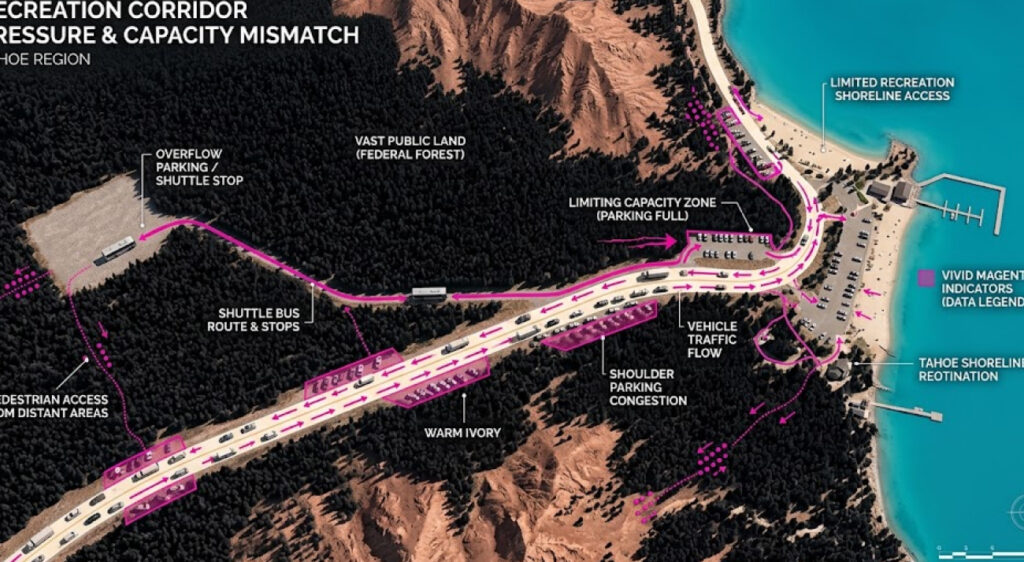
Eagle Falls illustrates the problem.
The trailhead provides access to some of the most heavily visited landscapes in the Sierra Nevada, yet the physical parking area cannot expand indefinitely without affecting the surrounding environment.
The proposed fee could therefore be viewed as a management tool rather than simply a revenue mechanism.
Charging for parking can discourage some visitors from arriving by individual vehicle, encourage carpooling and potentially reduce turnover pressure.
However, the success of that strategy depends on what happens next.
If visitors are given a paid parking area without better transportation alternatives, the policy may simply transfer the inconvenience rather than solving the underlying capacity problem.
Desolation Wilderness Faces A Different Fee Question
The proposal also reaches beyond parking.
The Forest Service is proposing higher overnight permit fees for Desolation Wilderness, one of the most heavily used wilderness areas in the Sierra Nevada.
Current overnight permits cost $5 per person, while an annual pass is available for $20. Under the proposal, the individual fee would rise to $10 during the first year and $15 by the fifth year, while the existing annual pass would be eliminated.
That is a more significant policy change than a parking increase because the fee would be directly connected to the experience of spending a night inside protected wilderness.
For a group of four hikers, the proposed fifth-year rate would represent $60 in permit fees for a single overnight trip.
For larger groups or repeat visitors, the difference becomes more substantial.
The Forest Service is effectively testing whether higher prices can help manage demand while generating additional resources for a landscape that faces increasing recreational pressure.
Lake Tahoe’s Popularity Has Created A Management Paradox
Lake Tahoe’s popularity is one of its greatest economic strengths and one of its most persistent management problems.
Visitors support hotels, restaurants, outdoor retailers, transportation companies, guides and other businesses throughout the basin. The destination’s recreation economy depends on people wanting to swim, hike, camp, paddle, photograph and explore the surrounding mountains.
But those same visitors create costs.
More people mean more vehicles, more trash, greater trail wear, more restroom demand and more emergency-management needs.
The paradox is that a destination can become so successful that the infrastructure supporting the visitor experience starts to become the limiting factor.
That is why the current debate deserves attention beyond Lake Tahoe.
Other California recreation destinations are confronting similar questions as public lands become increasingly popular.
The issue is no longer simply how to attract visitors.
It is increasingly about how to manage successful destinations without damaging the natural resources that attract people in the first place.
California’s Coastal Destinations Face A Similar Challenge
The same tension can be seen in California’s coastal recreation system, where rising visitor pressure is influencing decisions about access, parking, wildlife protection and infrastructure.
Recent discussions surrounding La Jolla Cove access provide another example of a destination where public access and environmental protection are increasingly difficult to separate. At La Jolla Cove, the central issue involves protecting sea lions and other marine wildlife while maintaining access to a highly popular San Diego attraction.
Lake Tahoe’s debate is different, but the underlying management question is similar.
How much access can a destination absorb before unrestricted visitation begins to threaten the quality of the environment and the visitor experience?
Fees are one possible answer.
They are not necessarily the only answer.
The Proposed Changes Do Not Mean Every Tahoe Visit Will Cost More
It is important for travelers to understand the scope of the proposal.
The Forest Service is not proposing to charge everyone simply for entering the Lake Tahoe region or walking onto every national forest trail.
Many recreation sites would remain free, and the Forest Service says more than 40% of Eldorado National Forest recreation sites would continue without a recreation fee under the broader proposal.
Visitors can also access some national forest lands without using developed facilities.
That means travelers who plan carefully may be able to adjust their itineraries rather than simply absorb every proposed fee.
For example, visitors could consider:
- Carpooling to popular trailheads where vehicle-based fees apply.
- Checking alternative recreation areas that remain free.
- Using public transportation where available.
- Planning visits outside peak periods.
- Checking current fee and parking information before departure.
The regional tourism industry is already encouraging visitors to plan around congestion and parking limitations, particularly at high-demand trailheads.
The September 29 Deadline Makes The Proposal Immediate
The Forest Service is currently accepting public comments on the proposed changes through September 29, 2026. Comments can be submitted electronically, by email or by mail to the Lake Tahoe Basin Management Unit.
That deadline means the proposal is still part of an active public process rather than a finalized fee schedule.
Visitors, residents, recreation groups and businesses therefore have an opportunity to influence how the system develops.
The most important question may not be whether Lake Tahoe should have recreation fees at all.
It is whether the fees are structured around the actual problems facing each location.
A $10 parking charge may make sense if it funds additional parking management, restroom maintenance and visitor services. A wilderness permit increase may be harder to justify if visitors do not see corresponding improvements in trail management, information systems or environmental protection.
Transparency will therefore be critical.
The Next Phase Of Tahoe Tourism Will Require More Than More Parking
Lake Tahoe’s recreation debate points toward a larger change in California outdoor travel.
For decades, the basic model was relatively simple: protect public lands, provide roads and facilities, and allow visitors to use them.
That model becomes harder to maintain when visitor numbers grow faster than infrastructure budgets.
The proposed Lake Tahoe fees represent an attempt to close that gap by asking visitors to contribute more directly to the cost of recreation.
Whether the strategy succeeds will depend on what visitors see in return.
If additional revenue produces cleaner facilities, better trail maintenance, safer parking, improved visitor information and stronger environmental protection, higher fees may become easier for the public to accept.
If visitors pay more while congestion, deteriorating facilities and access problems remain unchanged, opposition is likely to grow.
For Lake Tahoe, the decision now being considered is therefore about more than a $10 parking charge at Kiva Beach or a $15 future permit for Desolation Wilderness. It is about defining how a heavily visited public landscape should operate when demand has reached the point where maintaining access itself has become expensive.
And with the September 29 comment deadline approaching, the region is entering an important phase in deciding whether the next era of Lake Tahoe recreation will prioritize unrestricted access, managed visitation, higher user fees—or some combination of all three.