

Big Sur’s latest disruption also highlights a broader issue facing California’s most popular coastal destinations: balancing tourism with changing environmental and safety conditions. A similar debate is unfolding farther south, where officials and wildlife advocates are examining how visitor pressure affects protected marine mammals at one of San Diego’s busiest coastal attractions. Our recent coverage of La Jolla Cove sea lion access restrictions examines how wildlife protection measures could reshape public access while preserving the area’s value as a major destination.
The disruption is particularly significant because Highway 1 had only recently recovered from a much longer closure caused by major landslide damage. The road reopened to through traffic earlier this year after approximately three years of transportation problems, giving hotels, restaurants, tour operators and other businesses a chance to rebuild visitor momentum.
The latest closure lasted 12 days, according to the Los Angeles Times, before Caltrans reopened the highway on August 22. However, reopening the road does not mean the tourism disruption is finished. Firefighters continue working in the region, some park closures remain in effect and conditions can change quickly as the Timber Fire continues burning in the surrounding mountains.
Timber Fire Quickly Changed Big Sur Travel Conditions
The Timber Fire was first reported late on August 8 in the rugged interior of Monterey County. By August 11, CAL FIRE reported approximately 2,989 acres burned, with containment at just 5%. More than 480 firefighters were assigned to the incident at that stage, supported by engines, hand crews, helicopters, water tenders and dozers.
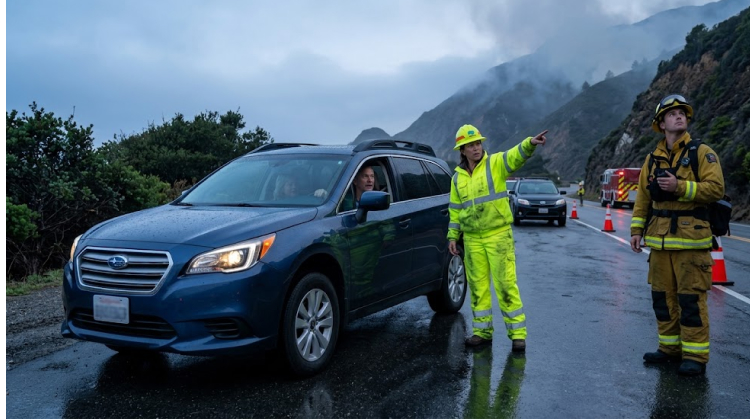
The fire’s location created an immediate transportation problem.
Highway 1 is more than a scenic road in Big Sur. It is the principal coastal route connecting communities, lodging properties, restaurants, recreation areas and state parks along the coastline. When portions of the road become inaccessible, visitors cannot simply take a parallel coastal highway to reach the same destinations.
On August 11, Caltrans District 5 announced the closure of approximately 10 miles of Highway 1 from two miles north of Julia Pfeiffer Burns State Park to Fernwood. Officials instructed travelers to avoid unnecessary trips through the affected area and use U.S. 101 as an alternate route.
That created a familiar problem for businesses that depend on visitors arriving specifically to experience Big Sur’s coastal landscape.
The latest California travel safety guidance is also relevant for visitors planning trips around active wildfire areas because road conditions, evacuation zones and air quality can change independently of normal tourism schedules.
Highway 1 Became Part Of The Firefighting Strategy
The highway closure was not simply a consequence of smoke or poor visibility.
Fire crews were actively using the Highway 1 corridor as part of their containment strategy. CAL FIRE reported that firefighters conducted strategic firing operations in areas near Partington Ridge and worked to bring portions of the fire toward the highway, where existing roads could provide useful control features.
That strategy demonstrates why travelers cannot evaluate Big Sur road conditions based only on whether flames are visible from the highway.
A road can remain closed because crews need room for emergency operations, utility work, debris removal, equipment movement or safety assessments.
On August 17, firefighters reported that they had successfully brought fire down toward Highway 1 near Partington Ridge. Crews were also continuing mop-up operations and working toward containment lines near the Big Sur River.
By August 18, the closure boundaries were adjusted as conditions improved. The northern closure moved closer to the Alila Ventana Resort and Post Ranch Inn area, while the southern boundary remained near the Julia Pfeiffer Burns State Park Vista Point.
The changes illustrate how quickly access can shift during an active wildfire.
Businesses Reopened When Highway 1 Returned
The reopening of Highway 1 on August 22 provided immediate relief to the local tourism economy.
The Los Angeles Times reported that the highway and many Big Sur businesses reopened after the 12-day closure, although firefighters continued battling the Timber Fire in surrounding canyons. Caltrans workers also continued making road improvements after reopening.
That distinction matters for visitors.
A reopened highway does not automatically mean every destination along it is operating normally.
Hotels may reopen before nearby parks. Restaurants can operate while trail systems remain closed. A road can be open for local access while individual attractions maintain restrictions.
Travelers therefore need to treat Big Sur as a collection of separate access points rather than one destination with a single operating status.
That is particularly important after a wildfire because conditions can vary dramatically between the coast, inland mountains and individual park properties.
The Fire Has Also Disrupted Remote Tourism
The Timber Fire’s impact extends beyond conventional sightseeing.
The Tassajara Zen Mountain Center, a remote Buddhist monastery operated by the San Francisco Zen Center, canceled the remainder of its summer season and began evacuating students because of deteriorating air quality associated with wildfire smoke. The center was not under an official evacuation order, but smoke conditions were enough to prompt voluntary departures.
The center had already canceled retreats scheduled through August 23 and halted new student admissions.
This is an important indicator of how wildfire disruption works in Big Sur.
The economic consequences do not require flames to reach a hotel, restaurant or attraction.
Smoke, transportation uncertainty and concerns about emergency access can be enough to cause visitors to cancel trips.
For tourism-dependent communities, that means the effective impact zone of a wildfire can extend well beyond the official burn perimeter.
Several Big Sur State Parks Were Forced To Close
The tourism impact extended beyond Highway 1.
California State Parks closed Point Sur State Historic Park, Andrew Molera State Park, Pfeiffer Big Sur State Park and Julia Pfeiffer Burns State Park as the Timber Fire grew. The closures were announced August 10 and were tied directly to public-safety concerns associated with the fire.
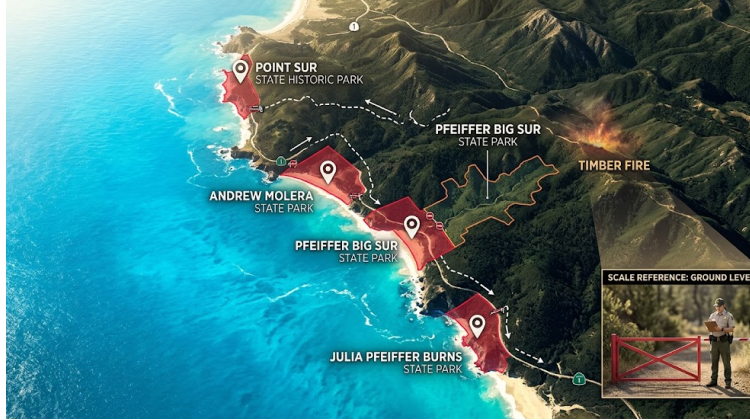
For travelers, that effectively removed several of Big Sur’s most recognizable recreational destinations from itineraries at the same time.
Julia Pfeiffer Burns State Park is especially important because its coastline and McWay Falls are among the most recognizable visual attractions along Highway 1. Andrew Molera provides access to trails and coastal landscapes, while Pfeiffer Big Sur is one of the region’s major recreation areas.
When multiple parks close simultaneously, the impact is different from losing a single trail.
It changes the structure of the entire visitor experience.
A traveler who has driven several hours to reach Big Sur may have planned stops at multiple parks, viewpoints and businesses. If several destinations become unavailable, the economic value of that trip can fall even if restaurants and hotels remain open.
As of the latest California State Parks update, Julia Pfeiffer Burns State Park remained closed because of the Timber Fire, demonstrating that highway reopening and recreational reopening do not necessarily happen at the same time.
Big Sur Tourism Was Already Recovering From A Highway Crisis
The Timber Fire arrived at a particularly sensitive moment for Big Sur.
Highway 1 has experienced repeated disruptions in recent years, including major landslides and storm damage. The most consequential closure lasted roughly three years before the coastal route fully reopened earlier in 2026.
That long interruption had forced businesses to operate in an environment where access could not be taken for granted.
The Timber Fire therefore represents more than another temporary road closure.
It creates another test for a tourism economy that had only recently regained reliable access to its principal transportation corridor.
The difference between a three-year infrastructure closure and a 12-day wildfire closure is enormous, but both expose the same structural vulnerability: Big Sur depends heavily on a single coastal road.
When Highway 1 is interrupted, there is no equivalent scenic coastal alternative that can reproduce the same visitor route.
The Highway’s Scenic Value Is Also Its Vulnerability
Highway 1’s importance to Big Sur comes partly from the geography that makes the area difficult to access.
The road follows cliffs and steep mountains along the Pacific coast. The same terrain that creates the spectacular scenery also makes road construction, maintenance and emergency response complicated.
There are few places where a second major road could simply be built alongside Highway 1.
That creates a transportation model in which the scenic value and logistical vulnerability are closely connected.
For tourism businesses, this means that a highway closure can immediately affect reservations, restaurant traffic, guided excursions and day-trip demand.
The Timber Fire exposed that vulnerability again.
Even after the highway reopened, the continuing fire meant that travelers had to monitor conditions rather than assume that the corridor had returned to normal.
Fire Conditions Remain A Moving Target
The Timber Fire’s size changed rapidly during its first two weeks.
CAL FIRE reported the fire at 3,150 acres on August 12, approximately 4,655 acres on August 15, and more than 6,100 acres by August 21. Containment also increased as crews established control lines, but active fire continued in portions of the wilderness.
More recent reporting placed the fire above 5,700 acres and 27% contained in the days immediately before the highway reopening, while subsequent reports indicated that the fire continued to grow in some areas.
These changing figures reinforce why wildfire tourism information has a short shelf life.
A road status published in the morning may become outdated later the same day.
Weather is another factor.
CAL FIRE reported that higher pressure was producing a warming and drying trend and compressing the marine layer. Coastal areas could remain cool and cloudy while higher elevations became substantially drier.
That contrast is particularly important in Big Sur, where visitors can experience fog near the ocean while wildfire conditions remain active only a short distance inland.
What Reopening Highway 1 Means For Visitors
The August 22 reopening is significant because it restores one of the most important components of Big Sur’s visitor economy.
However, travelers should not interpret the reopening as a guarantee that every attraction is operating.
A practical Big Sur trip now requires checking several conditions before departure:
- Highway 1 status and current Caltrans travel information.
- Individual California State Parks closures and trail conditions.
- Evacuation orders and warnings in Monterey County.
- Current wildfire activity and smoke conditions.
- Business operating status before making long-distance plans.
The most useful approach is to check official sources shortly before traveling rather than relying on older social-media posts, cached maps or travel articles.
Visitors can monitor Caltrans QuickMap for current highway conditions and closures. Caltrans specifically directed travelers to official road information during the Timber Fire closure.
Big Sur’s Tourism Model Is Becoming More Resilient By Necessity
The Timber Fire demonstrates that Big Sur’s tourism economy cannot depend entirely on uninterrupted Highway 1 access.
Hotels, restaurants and attractions have increasingly had to operate around disruptions caused by wildfire, landslides, storms and other emergencies.
That does not mean Big Sur’s tourism model is failing.
It means resilience is becoming part of the destination’s operating reality.
Businesses can reduce exposure by communicating rapidly with guests, offering flexible reservation policies and maintaining current information about access. Travelers can reduce unnecessary risk by checking road and park conditions before departure.
Public agencies face a more complicated responsibility: maintaining the road while protecting firefighters, residents and visitors during emergencies.
The August closure demonstrated that these priorities sometimes require tourism to temporarily take a back seat.
Conservation And Tourism Are Now Interconnected
Another development emerging from the Timber Fire is that Big Sur’s tourism future depends on more than roads and hotels.
The region recently gained additional protected land when two properties totaling 247 acres were added to the Los Padres National Forest and expanded the Ventana Wilderness. One 160-acre parcel near the Tassajara Zen Mountain Center contains an important trail connection, while an 87-acre property along the Little Sur River includes redwood habitat and portions of the Little Sur and Mount Manuel trails.
Those properties sit outside the Timber Fire’s burn zone.
Their protection demonstrates the other side of Big Sur’s relationship with tourism.
Visitors are attracted to the region because of its forests, rivers, mountains, cliffs and coastline. Protecting those landscapes is therefore also an investment in the destination’s long-term identity.
At the same time, wildfire management will increasingly determine when and how visitors can experience those landscapes.
The Next Big Sur Season Will Depend On More Than A Reopened Road
Highway 1 is open again, but Big Sur has not simply returned to the conditions that existed before August 8.
The Timber Fire continues to affect the surrounding landscape, some state parks remain closed, and firefighters are still managing active areas of the incident.
For local businesses, the reopening provides an opportunity to recover lost visitor traffic.
For travelers, it offers a chance to return to the coast—but with a greater need for preparation.
The larger lesson is becoming increasingly clear. Big Sur’s tourism economy is inseparable from the condition of Highway 1, and Highway 1 is inseparable from the fire-prone mountains that surround it. Every major wildfire, landslide or storm therefore becomes more than an emergency-management story. It becomes a tourism story, a transportation story and an economic story at the same time.
The Timber Fire has once again shown how quickly that connection can become visible.
For now, visitors can return to portions of the Big Sur corridor, but the region’s recovery will depend on how quickly individual parks reopen, how the fire behaves through the remainder of the season and whether travelers regain confidence that a trip along California’s most famous coastal highway will remain accessible from one week to the next.