

Imperial Beach is confronting another setback in its long-running battle with Tijuana River pollution after San Diego County expanded a beach water-contact closure to Cortez Avenue on August 22–23, 2026. The restriction was added to existing closures covering the Tijuana Slough, the end of Seacoast Drive, Imperial Beach Pier and Carnation Avenue after officials determined that flows from the Tijuana River were reaching recreational waters. County health officials warned that the ocean water contains sewage and could cause illness.
The latest closure is significant because it comes only weeks after some Imperial Beach areas experienced a rare improvement in water quality. On August 6, county officials said water near Imperial Beach Pier was safe for swimming for the first time in 2026. Within days, however, contamination concerns returned after rain increased the risk of polluted flows reaching the coast.
That cycle—brief reopening followed by another warning or closure—has become central to the region’s tourism and public-access problem.
For Imperial Beach, the issue is no longer simply whether a visitor can swim on a particular weekend. The larger challenge is whether a coastal community can maintain a reliable recreation economy when the condition of its primary natural attraction can change within days.
Imperial Beach Adds Cortez Avenue To Existing Beach Closures
The latest county action expanded the affected coastline to include the area around Cortez Avenue, adding another public access point to a closure network already affecting several locations.
As of the August 23 announcement, the shoreline from the international border to three-quarters of a mile north of the Tijuana River, along with Imperial Beach Pier, Carnation Avenue, the end of Seacoast Drive and Cortez Avenue, remained closed to water contact until testing and field observations confirmed that conditions were safe.
The closure does not mean the entire city is inaccessible. Visitors can still reach Imperial Beach and use portions of the coastal area for activities that do not involve contact with contaminated water, subject to current local guidance. The critical distinction is that swimming, surfing, wading and other activities that put people directly in contact with ocean water are restricted in affected areas.
| Location | Current Management Action | Primary Concern |
|---|---|---|
| Cortez Avenue | Water-contact closure | Sewage-contaminated water |
| Carnation Avenue | Water-contact closure | Tijuana River flows |
| Imperial Beach Pier | Water-contact closure | Bacteria and sewage |
| End of Seacoast Drive | Water-contact closure | Recreational water contamination |
| Tijuana Slough | Water-contact closure | Transboundary pollution |
| Avenida Lunar, Coronado | Health advisory | Elevated bacteria |
The county has also maintained advisories farther north, including Children’s Pool in La Jolla, Tourmaline Surf Park in Pacific Beach and the beach near Vallecitos Street and Kellogg Park, where officials have warned that bacteria levels exceed state health standards.
For travelers, that makes checking conditions before entering the water particularly important.
The Tijuana River Makes Water Quality Difficult To Predict
The fundamental problem begins upstream.
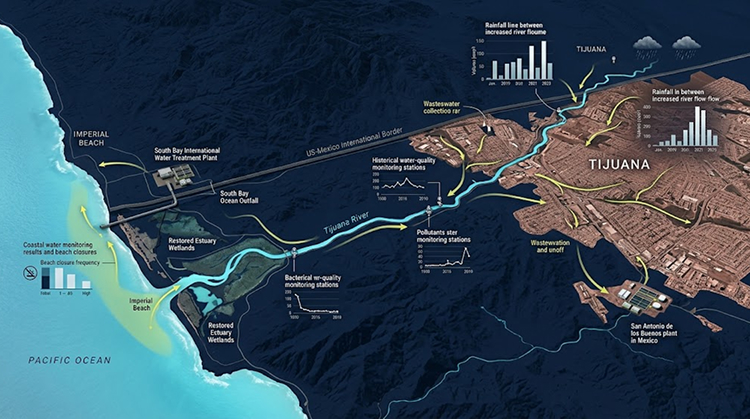
The Tijuana River crosses the U.S.-Mexico border before flowing north through the Tijuana River Valley and eventually reaching the Pacific Ocean near Imperial Beach. When polluted flows enter the river system, contaminants can move toward the coast, creating a direct connection between conditions in the watershed and the safety of Southern California beaches.
The City of Imperial Beach describes transboundary pollution from Mexico as a severe threat to water quality, public health and the environment throughout the border region. The city notes that flows during severe events can reach hundreds of millions of gallons per day.
The challenge is intensified by the fact that the contamination is not necessarily limited to periods of heavy rainfall.
The watershed has experienced chronic wastewater infrastructure problems, including failures and capacity issues in the systems serving the Tijuana metropolitan area. When wastewater cannot be adequately captured, treated or conveyed, contaminated flows can enter the Tijuana River and eventually reach U.S. waters.
That means a beach can improve temporarily without the underlying regional problem being solved.
A Rare August Reopening Lasted Only Briefly
The events of August demonstrate how quickly conditions can change.
On August 6, NBC 7 reported that water near Imperial Beach Pier had finally tested clean enough for swimming. The moment was unusual because yellow warning signs had been a familiar feature of the shoreline for much of the previous several years.
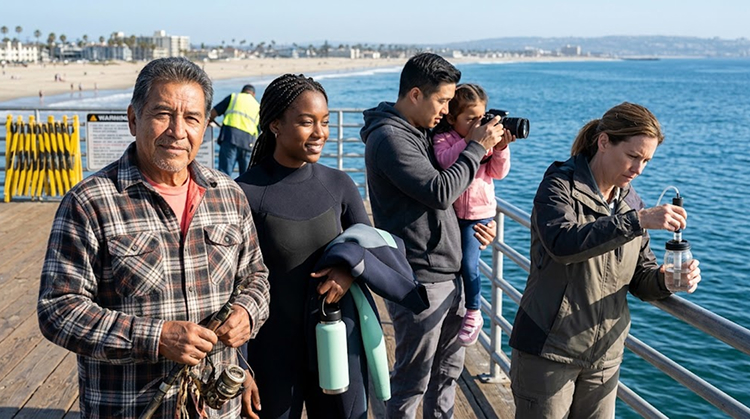
The reopening offered residents and visitors a glimpse of what normal coastal recreation could look like again.
People returned to the pier. Some residents who had avoided the area for years began fishing again. The beach briefly operated without sewage-related water-quality warnings.
Then rain changed the situation.
NBC 7 reported on August 9 that contamination warnings returned after rainfall triggered renewed concerns about sewage reaching the ocean.
That short window illustrates why the crisis is so difficult for tourism businesses to manage.
A restaurant, hotel, surf shop or rental operator cannot easily plan around a beach that may be open one week and closed the next. A visitor traveling from another part of California may book accommodations expecting a traditional beach weekend, only to discover that water activities are prohibited when they arrive.
The unpredictability can be as damaging as the closure itself.
Imperial Beach Has Endured Years Of Disruption
The latest restrictions are part of a much larger history.
A 2026 Beach Report Card from Heal the Bay found that the Imperial Beach shoreline was closed for more than 90% of the days during the previous reporting year, while the Coronado shoreline several miles north was closed for more than 50% of days.
Those numbers put the current closure into perspective.
A temporary beach closure after a storm is a familiar coastal management tool. Communities throughout California close beaches when bacteria levels rise following rainfall, sewage spills or other contamination events.
Imperial Beach faces something different: a persistent transboundary pollution problem that can repeatedly produce the same outcome.
The result is an unusual contradiction.
Imperial Beach remains a beautiful Southern California coastal destination with a broad sandy shoreline, a pier, restaurants, residential neighborhoods and access to the Tijuana River Valley. Yet the central recreational activity associated with the location—entering the ocean—can be prohibited for extended periods.
That disconnect creates economic consequences that extend beyond the beach itself.
Tourism Businesses Face A Difficult Planning Environment
For local businesses, beach access is part of the destination’s economic infrastructure.
Hotels depend on visitors who want a coastal experience. Restaurants benefit from beach traffic. Surfing and recreational businesses depend directly on people entering the water. Retailers and other local businesses benefit from the broader visitor economy.
When the ocean becomes inaccessible, the effects can spread through the commercial district.
The City of Imperial Beach has previously described the pollution crisis as having serious economic and public-health consequences for the community.
The challenge is particularly significant because visitors do not necessarily distinguish between different causes of a closure.
From a traveler’s perspective, the result is simple: the beach is closed.
Whether the cause is sewage, bacteria, runoff or another environmental hazard, the visitor experience changes immediately.
That makes water-quality reliability a tourism issue as much as an environmental one.
Infrastructure Improvements Are Underway But The Crisis Is Not Over
There is an important distinction between the latest beach closure and the long-term effort to address its causes.
Federal officials have been working with Mexico on infrastructure improvements intended to reduce the flow of untreated wastewater toward the United States.
The U.S. Environmental Protection Agency released its second quarterly 2026 update on June 30, outlining progress under agreements between the United States and Mexico intended to address the Tijuana River sewage crisis. The update said rehabilitation of the Parallel Gravity Line was expected to be completed in August 2026.
The same EPA update documented two significant failures of the Parallel Gravity Main in May. One collapse was reported on May 14, with emergency repairs completed May 16. A second collapse was reported May 31, followed by repairs completed June 4.
Those incidents demonstrate why infrastructure remains central to the crisis.
Even when treatment and diversion systems are operating, a failure in a major conveyance line can place additional pressure on downstream facilities.
The South Bay International Wastewater Treatment Plant also plays a critical role in the system. During the May failures, the EPA said the U.S. International Boundary and Water Commission deployed additional staff and equipment to treat flows exceeding 40 million gallons per day.
The infrastructure response therefore involves multiple agencies and two countries.
The Environmental Cost Extends Beyond Imperial Beach
The problem is not limited to swimmers.
The Tijuana River Valley contains sensitive wetlands, estuarine habitat and protected natural areas. The polluted flows can affect wildlife, sediment quality and coastal ecosystems before reaching the Pacific.
The city of Imperial Beach specifically identifies the Tijuana River National Estuarine Research Reserve and Border Field State Park among the natural areas affected by pollution moving through the watershed.
That creates another layer of complexity for California’s coastal management system.
The region is simultaneously trying to preserve sensitive ecosystems, protect public health and maintain access to recreational destinations.
These objectives normally complement one another. In Imperial Beach, however, pollution can force authorities to restrict access precisely because protecting the environment and public requires temporarily preventing recreation.
The result is a coastal landscape where conservation and tourism are increasingly connected to infrastructure policy.
The Crisis Is Becoming A Broader California Coastal Access Issue
Imperial Beach is not the only California destination where environmental conditions are reshaping public access.
Farther north, communities are dealing with erosion, wildfire, marine heat and changing coastal conditions. In San Diego County, wildlife protection is also influencing visitor access. At La Jolla Cove, growing concerns over human interactions with sea lions have raised questions about how public access should be managed around sensitive marine habitat.
Our recent coverage of La Jolla Cove access restrictions examines how wildlife protection could change the experience at another heavily visited San Diego coastal destination.
The circumstances are different, but the management question is similar: how can California maintain public access without allowing visitor activity or environmental deterioration to undermine the resource itself?
Imperial Beach adds another dimension because the threat is coming from outside the immediate coastline.
Rain Could Make The Problem More Difficult
Weather is another variable that can rapidly change conditions.
Rainfall can increase flows through the Tijuana River watershed and move additional contaminants toward the ocean. That makes storm periods particularly important for beach management.
The August sequence demonstrated the issue clearly: water conditions improved enough for the Imperial Beach Pier to reopen, then rainfall contributed to the return of contamination concerns within days.
Officials therefore have to operate with a precautionary approach.
Testing provides information about current conditions, but coastal water moves. Bacteria and contaminants can be transported by currents, while river flows can change rapidly.
For visitors, that means yesterday’s beach status is not necessarily a reliable indicator of today’s conditions.
The most useful resource for travelers is the county’s current beach monitoring information. Visitors should check San Diego beach water quality updates before entering the ocean, particularly after rain or when traveling near the Tijuana River outlet.
Imperial Beach Is Testing The Limits Of Coastal Tourism
The latest closure at Cortez Avenue represents more than another temporary restriction.
It shows how a decades-long infrastructure problem can eventually become a defining feature of a destination’s relationship with tourism.
Imperial Beach does not lack natural attractions. Its challenge is keeping those attractions reliably accessible and safe.
The community’s experience also demonstrates why coastal tourism cannot be separated from water infrastructure. Beaches may be public resources, but the ability to use them depends on systems operating far beyond the shoreline.
Treatment plants, collection systems, diversion infrastructure, international cooperation, water-quality testing and emergency response all influence whether someone can safely swim in the Pacific.
That reality makes the Tijuana River crisis unusually important for California.
The state’s coastal economy depends heavily on public beaches, but public access is only sustainable when the environmental systems supporting those beaches are functioning.
The Next Test Will Be Whether Reopenings Can Become Permanent
For Imperial Beach, the most meaningful sign of progress will not be a single day without warning signs.
It will be the ability to maintain safe water conditions consistently.
The August 6 reopening demonstrated that improvements in water quality are possible. The subsequent return of contamination warnings demonstrated that those improvements remain vulnerable to changes in river flow and weather.
That is why the current closure deserves attention beyond the immediate travel inconvenience.
If infrastructure projects reduce transboundary wastewater flows, Imperial Beach could gradually move toward a more predictable recreational environment. If major failures continue or wastewater capacity remains inadequate, repeated closures will remain a structural problem for the community.
For visitors planning a Southern California coastal trip, the practical lesson is immediate: check water conditions before entering the ocean, especially after rainfall, and treat county closure signs as active public-health warnings rather than routine beach advisories.
For Imperial Beach, the larger goal is considerably more ambitious.
The community needs its beach to become predictable again—not merely open for a day, but safe and accessible often enough that residents, businesses and visitors can once again plan their relationship with the Pacific without waiting to see what the Tijuana River will bring next.