

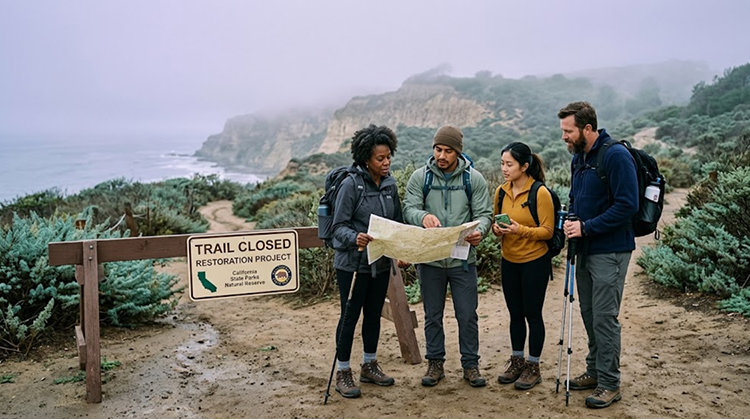
Torrey Pines State Natural Reserve has closed its trails, upper parking lots, Beach Trail staircase and main access road as California State Parks begins the next phase of a major infrastructure project in San Diego County. The closure started Tuesday, September 22, 2026, and is expected to continue until March 2027, temporarily removing one of Southern California’s most recognizable hiking destinations from the region’s normal recreation schedule.
The shutdown is broader than a typical trail closure. Pedestrians, bicyclists and vehicles are all prohibited from entering the reserve during the construction period. The Lodge and Trail Interpretive Kiosk are also closed, while Torrey Pines State Beach and its North and South Beach parking lots remain available. California State Parks says the project is focused on utility improvements, a replacement restroom facility and accessibility upgrades that will serve a reserve receiving more than 4 million visitors annually. California State Parks’ Torrey Pines closure announcement
For San Diego residents and travelers, the timing creates a significant change just as fall hiking conditions begin to improve. For the reserve itself, the interruption is tied to work that has been planned in phases because construction has to coexist with sensitive coastal habitat.
Torrey Pines Is Closed To Visitors Until March 2027
The current closure covers virtually all of the main visitor experience at Torrey Pines State Natural Reserve. Starting September 22, State Parks closed the reserve to pedestrians, bicyclists and vehicles, including every trail inside the main reserve, the Beach Trail staircase, both upper parking lots and the Lodge.
The road closure began one day earlier, on September 21. That earlier shutdown also ended vehicle access and closed the Lodge and Trail Interpretive Kiosk for the season.
State Parks currently lists the reserve as closed, with reopening scheduled for March 2027. Its construction information page gives the anticipated completion date as around March 1, 2027, although visitors should check official updates before planning a return because construction schedules can change. Current Torrey Pines construction information
The closure effectively separates the reserve from the adjacent beach. Visitors can still reach the shoreline through the North Beach and South Beach parking areas, but they cannot use the reserve’s trails to climb into the cliffs and coastal pine habitat above it.
That distinction matters because Torrey Pines State Natural Reserve and Torrey Pines State Beach are separate visitor areas even though they share the same coastal landscape.
The Beach Will Stay Open While The Reserve Closes
The closure does not mean that the entire Torrey Pines coastline is off limits.
Torrey Pines State Beach remains open, as do the North Beach and South Beach parking lots. The beach stretches along the coastline between La Jolla and Del Mar and provides access to a roughly 4.5-mile section of sand beneath the coastal bluffs.
That creates an unusual situation for visitors: the oceanfront landscape remains accessible from below while the hiking terrain above the cliffs is closed.
California State Parks has confirmed that the South Beach and North Beach parking areas will continue serving visitors during the construction period. The state also says existing California State Parks annual passes remain valid at other participating locations, including several North County beaches. Torrey Pines State Beach visitor information
Visitors heading to the area should therefore avoid assuming that a beach parking lot provides access to the reserve. The trails, upper lots and Beach Trail staircase are part of the construction closure.
For people who normally combine a beach visit with a morning hike through the reserve, that routine will have to change until construction is finished.
The Project Goes Beyond A New Restroom
The most visible long-term result may be a new restroom facility, but the work is much broader than replacing an aging building.
State Parks says the project includes new gas, water, wastewater and communication lines. The work also includes accessibility improvements such as updated accessible parking stalls and a paved accessible pedestrian route connecting the upper parking area with the restroom and Lodge.
Much of the first phase focused on infrastructure beneath the surface. The second phase continues that work while moving toward improvements visitors will eventually see and use.
The project is especially significant because the reserve has to support millions of visitors while protecting a landscape with unusually high conservation value. State Parks says the infrastructure being developed is intended to support modern facilities for more than 4 million annual visitors.
That combination creates a difficult management equation. Torrey Pines has to accommodate heavy public use without treating a protected natural reserve like an ordinary urban recreation facility.
Construction Is Being Scheduled Around Sensitive Wildlife
The timing of the project is also connected to wildlife protection.
California State Parks says construction schedules are dictated in part by the nesting season of the California gnatcatcher, a federally protected bird associated with coastal sage scrub habitat. Work is paused during the bird’s most sensitive nesting period, which is one reason the larger project has been divided into phases rather than handled as a single uninterrupted construction period.
The reserve also contains rare Torrey pine habitat and coastal sage scrub that require additional monitoring during construction.
This is one reason the project cannot simply be treated as a conventional road, restroom or utility upgrade. Construction has to take place within a protected landscape where excavation, vehicle movement and infrastructure installation can affect vegetation, wildlife and soil.
The state’s construction plan explains that phasing allows crews to monitor impacts on coastal sage scrub and Torrey pines while still moving forward with visitor improvements. Torrey Pines construction project details
Torrey Pines Protects One Of America’s Rarest Pines
The infrastructure project is taking place in a landscape whose ecological importance extends far beyond San Diego’s hiking community.
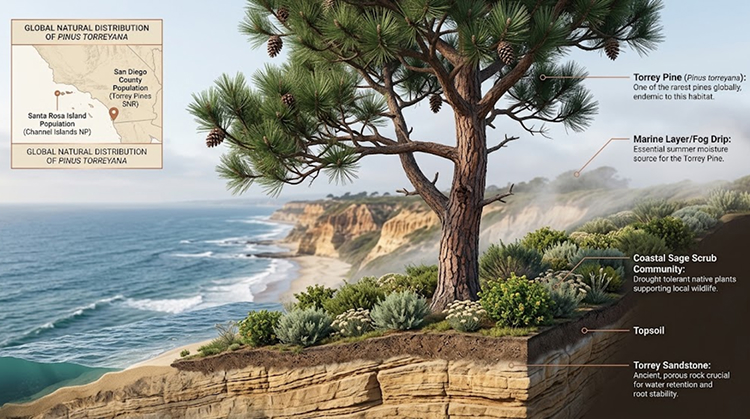
The reserve protects the mainland population of the Torrey pine, Pinus torreyana, one of the rarest native pine trees in the United States. The National Park Service notes that Torrey pines naturally occur in only two locations: the San Diego area and Santa Rosa Island in Channel Islands National Park.
That makes the San Diego population particularly important because the tree’s natural range is extremely limited.
The reserve’s landscape also includes steep sandstone cliffs, coastal sage scrub, deep ravines and habitat associated with Southern California’s coastal ecosystems. National Park Service information on Torrey Pines
The ecological story has become even more relevant this year because the other naturally occurring Torrey pine population on Santa Rosa Island was heavily affected by the 2026 Santa Rosa Island Fire.
The National Park Service reported in September that initial assessments indicated that 60% to 80% of Santa Rosa Island’s iconic Torrey pines could die following the fire, which burned 18,379 acres between May 15 and June 4.
That does not mean the San Diego reserve is facing the same immediate threat. It does show why protecting the remaining natural populations of this rare tree has significance beyond the boundaries of one San Diego hiking destination. National Park Service Santa Rosa Island fire assessment
The Closure Changes Fall Hiking Across San Diego
For hikers, the biggest consequence is straightforward: the trails that normally provide access to Torrey Pines’ sandstone cliffs and ocean overlooks are unavailable for the fall and winter season.
The closure removes a destination that is especially popular because of its combination of short trails, coastal scenery and proximity to major San Diego communities.
The reserve sits north of La Jolla and south of Del Mar, placing it within an urbanized part of the county while maintaining a landscape that feels substantially more isolated once visitors climb above the beach.
With those trails unavailable, demand is likely to shift toward other coastal parks, preserves and trail systems across San Diego County.
State Parks itself points visitors toward other California state parks within 50 miles of the reserve. The agency lists 28 state parks in that radius, giving visitors a broad set of alternatives rather than treating the closure as an end to local outdoor recreation. California State Park Finder
Visitors who want to keep exploring the San Diego coast can also use the Torrey Pines State Beach area, although the experience is fundamentally different from hiking the reserve’s interior trails.
What Visitors Can Still Do At Torrey Pines
The most practical option during construction is to separate the beach experience from the reserve experience.
Visitors can still walk along Torrey Pines State Beach, use the North and South Beach parking areas and enjoy views of the sandstone cliffs from below. The beach also provides a different perspective on the landscape that hikers normally see from the upper trails.
State Parks says the North Beach parking area is accessed from Carmel Valley Road and McGonigle Road, while South Beach is accessed from North Torrey Pines Road.
There are also accessibility resources at the beach. California State Parks currently provides a free beach wheelchair through the North Beach area, available on a first-come, first-served basis. Torrey Pines State Beach access information
Visitors should still check conditions before leaving because parking availability, beach conditions and construction activity can change.
One useful alternative is to explore another San Diego-area destination rather than attempting to enter the closed reserve. California State Parks specifically recommends using its statewide park finder during the closure.
For CaliforniaTimes readers following coastal recreation and wildfire-related access changes, the Angel Island prescribed fire story provides another example of how California parks can remain important visitor destinations while access is temporarily modified for environmental management and safety work.
The Six-Month Shutdown Is Part Of A Longer Project
The current closure should be viewed as one stage of a multiyear improvement effort rather than a standalone construction event.
State Parks previously completed an initial phase that included major underground utility work and demolition of the old restroom facility. The second phase now resumes construction and focuses on completing utilities, building the new visitor facilities and improving accessibility.
The phased schedule also reflects the special requirements of a natural reserve. Work windows have to account for nesting wildlife, sensitive vegetation and monitoring requirements.
That makes the six-month closure more consequential than a simple renovation at a conventional park. The agency is using a concentrated closure period to perform work that would be more difficult, disruptive or environmentally risky if visitor traffic continued through the active construction zone.
The reserve’s location also makes the project highly visible. Millions of annual visitors mean that even a temporary change in access affects local recreation patterns, tourism itineraries and businesses that serve visitors along the San Diego coast.
March 2027 Will Bring Back A Different Torrey Pines
When Torrey Pines State Natural Reserve reopens, visitors should expect the same cliffs, rare pines and ocean views, but with infrastructure intended to handle contemporary use more effectively.
The completed project is expected to provide upgraded utility systems, a replacement restroom facility, new accessible parking spaces and an accessible pedestrian connection between the upper parking area, restroom and Lodge.
The goal is not to turn Torrey Pines into a more developed recreation complex. The construction is intended to modernize the systems supporting a heavily visited protected landscape while maintaining the reserve’s conservation standards.
That distinction will matter once the gates reopen.
Torrey Pines is one of those rare California destinations where a major metropolitan area and a highly protected natural landscape meet within a relatively small geographic area. Its closure highlights the physical infrastructure required to maintain that relationship and the environmental limits that determine how the work can be performed.
For now, visitors can still reach the beach, see the cliffs from below and explore other San Diego-area parks. The trails above the coastline, the upper parking lots and the reserve itself will remain off the itinerary until the current construction phase is completed, with full access expected to return in March 2027.