

San Clemente, California, is confronting a coastal erosion crisis that threatens its beaches, outdoor recreation, oceanfront properties, and one of Southern California’s most important transportation links. Repeated high surf, rising sea levels, and declining supplies of beach sand have left sections of the shoreline increasingly vulnerable, raising questions about how the city can preserve its coastal character while protecting the railway that connects Los Angeles, Orange County, and San Diego.
The issue drew renewed attention in October 2026 after waves and high tides damaged the San Clemente coastline and brought erosion close to railroad infrastructure. On October 8, the Los Angeles Times reported that California transportation officials expected to launch a study examining the possibility of relocating vulnerable portions of the coastal railway. Orange County Transportation Authority (OCTA) Chief Executive Officer Darrell Johnson said the study would take several months, with no relocation decision made at that stage. Estimates cited in the report suggested moving the tracks inland could cost more than $5 billion.
The problem extends beyond transportation. San Clemente’s sandy beaches support surfing, swimming, walking, tourism, and the local businesses that depend on visitors. As sand disappears, waves can reach protective rock structures, coastal bluffs, and rail embankments with greater force. The city must therefore weigh immediate repairs against longer-term strategies that could reshape how people access and use the coastline.
San Clemente’s Beaches Are Losing Their Natural Sand Buffer
San Clemente has long been known for its broad sandy beaches and surf culture, but several stretches of shoreline have become noticeably narrower. According to reporting published by The Guardian on October 18, 2026, local beach-restoration advocates estimate that the coastline faces a deficit of approximately 4 million to 6 million cubic yards of sand. The city’s own planning documents describe a broader estimated deficit of 5 million to 9 million cubic yards, reflecting differences in assessment scope and methodology.
The loss of sand matters because a beach serves as more than a recreational surface. It absorbs and redistributes wave energy, creating a buffer between the ocean and infrastructure located along the shore. When that buffer becomes narrower, waves can reach protective rocks, coastal bluffs, pedestrian paths, and railway embankments more frequently.
San Clemente’s beaches also depend on sediment moving naturally along the coast and downstream from rivers. Dams, channel modifications, urban development, and harbor infrastructure have altered sediment flows, reducing the amount of material reaching some Southern California beaches. Warmer ocean conditions and rising sea levels add further pressure by allowing waves and high tides to reach farther inland.
Historically, the city benefited from large quantities of sand associated with construction at Dana Point Harbor in the late 1960s. The material helped expand and replenish local beaches for decades. However, that legacy supply cannot be assumed to continue indefinitely, and replacing lost sand has become more difficult as coastal communities compete for suitable material.
The result is a growing mismatch between the natural processes that shape the coastline and the infrastructure built close to the water. San Clemente’s challenge is to restore enough sand to protect its beaches while determining how much long-term protection the railway and other coastal assets will require.
Coastal Erosion Has Repeatedly Disrupted The Rail Corridor
The railway running through San Clemente forms part of the LOSSAN corridor, which connects San Diego, Los Angeles, Orange County, and communities farther north toward San Luis Obispo. It carries Amtrak Pacific Surfliner and Metrolink passenger services, along with freight and military transportation.
Its position beside the Pacific provides some of the region’s most scenic rail travel, but it also places the tracks between two vulnerable features: the ocean on one side and coastal bluffs on the other.
The Los Angeles Times reported on October 8 that sections of the railway had experienced repeated interruptions from landslides, rockfalls, coastal erosion, and high tides. Since 2021, the line has been shut down multiple times for repairs in San Clemente and farther south along the coast. Severe wave activity in September 2026 again prompted a temporary closure after waves overtopped the tracks and damaged portions of the adjacent slope and existing protective rock.
These interruptions can affect more than trains passing through the city. When a section of track closes, passenger services may require cancellations, bus connections, schedule changes, or alternative travel arrangements. Freight operators can also face delays, while railway crews and equipment may need to be reassigned from other maintenance projects.
The transportation consequences extend across Southern California because multiple services use shared sections of the network. Fiailoa Ah Sue, Metrolink’s assistant director of track and structures maintenance, told the Los Angeles Times that rail disruptions can have cascading effects across the wider system.
For passengers, the immediate concern is reliable service. For transportation planners, the bigger question is whether repeated emergency repairs can keep the existing alignment operational as coastal conditions continue to change.
OCTA Completes A $93 Million Coastal Protection Project
San Clemente has already seen major investment in efforts to protect the railway while restoring public access to the coast. On October 9, 2026, OCTA officially reopened a section of the San Clemente Beach Trail at Mariposa Point after completing a project valued at approximately $93 million.
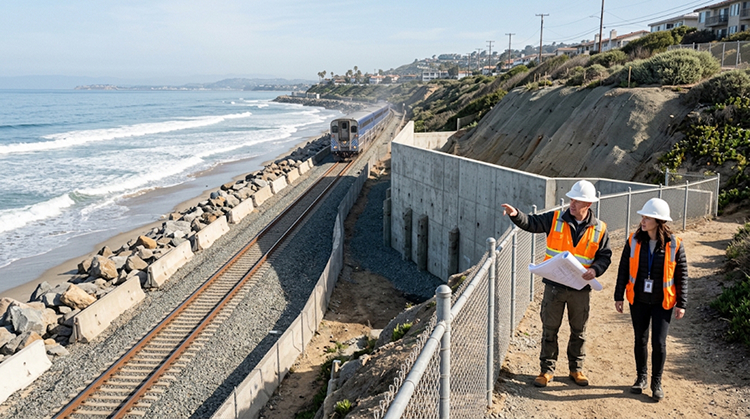
The project includes a nearly 1,400-foot catchment wall designed to protect the tracks from falling rocks, soil, and debris from the adjacent coastal bluff. Construction began in September 2025, following years of erosion-related problems and a January 2024 landslide that deposited soil and debris on the railway and destroyed a pedestrian bridge, interrupting passenger rail service.
The work also rebuilt and improved the pedestrian trail beside the railway, restoring a popular coastal connection for residents and visitors. Approximately $24 million of the overall project cost was allocated to the trail, with funding primarily from state and federal sources. The remainder supported the rail-protection work and related improvements.
The reopening demonstrates that rail protection and public recreation can sometimes be addressed through the same project. A stable bluff and protected track can help maintain transportation service, while a rebuilt path restores access to the shoreline.
However, the Mariposa Point project is one component of a much larger effort. OCTA has identified several vulnerable locations along the San Clemente coast and is pursuing emergency reinforcement, shoreline protection, and sand placement. The agency has secured more than $300 million in state and federal funding for coastal rail stabilization measures. It has also discussed placing up to 690,000 cubic yards of sand to help buffer the railway from wave action.
These projects can reduce immediate risks, but they do not eliminate the underlying shortage of beach sand or guarantee that the same protective measures will remain sufficient under future coastal conditions.
Could San Clemente’s Coastal Railway Move Inland?
The possibility of moving the railway away from the most vulnerable parts of the shoreline has become a major subject of transportation planning. According to the Los Angeles Times, California transportation officials were expected to initiate a study before the end of 2026 to examine what relocation could involve.
Darrell Johnson, OCTA’s chief executive, said the study would likely require several months. The estimated cost of relocating the tracks inland could exceed $5 billion, although that figure is an early estimate rather than an approved project budget. California transportation officials emphasized that no decision had been made about whether the railway would move, where a new alignment might run, or how a relocation would be funded.
Moving a major railway is a complex undertaking. Planners would need to evaluate engineering feasibility, environmental impacts, land acquisition, community effects, construction costs, and the needs of passenger, freight, and military users. A new route would also require coordination among local, state, and federal agencies, as well as railway owners and operators.
OCTA’s existing Coastal Rail Resiliency Study has examined strategies for protecting approximately seven miles of railway through San Clemente and Dana Point over a period of up to 30 years. Options include bluff stabilization, catchment walls, sand placement, engineered revetments, seawalls, and improvements to railway foundations.
These measures differ significantly in cost, environmental impact, and effectiveness. Some could extend the life of the existing route, while others might be needed to protect particularly exposed stretches. Relocation could reduce the railway’s direct exposure to waves, but would create a new set of engineering, environmental, and funding challenges.
The near-term priority remains keeping the existing railway safe and operational while officials assess longer-term alternatives.
Beach Restoration Could Help Protect Recreation And Infrastructure
For San Clemente, adding sand to beaches is about more than improving their appearance. A wider beach can provide a buffer between waves and the built environment, support recreation, and preserve the coastal experience that attracts residents and visitors.
The city has already carried out several replenishment projects. Its planning documents record the placement of 5,000 cubic yards of sand at North Beach in 2005, another 12,000 cubic yards in 2016, and 37,000 cubic yards in 2024. A larger project in 2024 added approximately 200,000 cubic yards to the main beaches north and south of the municipal pier. OCTA also placed 2,500 cubic yards at North Beach in 2025. The documented total from these projects is approximately 256,000 cubic yards.
These amounts are substantial, but they remain far below the larger sand-deficit estimates described in city planning documents. Replenishment also requires suitable sand, funding, permits, and a strategy for managing how waves and currents redistribute the material after placement.
OCTA has pursued additional sand placement alongside other protective measures, including reinforcement of existing rock structures. The goal is to restore a buffer that reduces the direct wave energy reaching the railway embankment before further high-surf and winter storm events.
Sand replenishment has limitations. Material can move offshore or along the coast, meaning a project may need future maintenance. The environmental consequences of sourcing, transporting, and placing sand also require evaluation.
Even so, replenishment remains one of the main approaches available for supporting beach access while reducing the pressure on shoreline infrastructure. The challenge is establishing a program that can deliver benefits over time rather than relying solely on emergency repairs after each damaging storm.
What Coastal Erosion Means For Visitors And Local Businesses
San Clemente’s beaches are important to surfers, swimmers, walkers, anglers, and families looking for access to the Pacific. The beach trail also provides a route for residents and visitors to experience the shoreline without relying on a car.
When erosion narrows the beach or construction restricts access, the effects are felt by local businesses as well as recreation users. Visitors may change their plans if a beach entrance is closed, a trail is interrupted, or train service is suspended. Restaurants, surf shops, accommodation providers, and other tourism businesses can experience the consequences of changing access and reduced visitor activity.
The reopening of the trail at Mariposa Point is therefore significant for both transportation and recreation. It restores a coastal route while marking progress on a major infrastructure project. Visitors should still check local notices before setting out, since construction, tides, and changing shoreline conditions can affect access elsewhere.
Travelers planning to use the Pacific Surfliner or Metrolink should verify current schedules through the relevant operator, particularly during periods of high surf or storm activity. A railway segment can be safe and open one day and require new inspections or repairs after another coastal event.
People visiting the beach should stay clear of active construction, protective rock structures, unstable bluffs, and any areas marked as closed. Waves can reach farther inland than expected during high tides, and wet or undercut slopes may fail without much warning.
For trip planning, the California destinations guide offers broader ideas for exploring the state. However, official beach, trail, and transportation updates should determine whether a specific San Clemente location is accessible on the day of a visit.
A Coastal Decision That Will Shape San Clemente’s Future
San Clemente’s erosion crisis reflects a challenge facing coastal communities throughout California: how to preserve beaches and public access while protecting transportation infrastructure and property in locations exposed to powerful waves and rising seas.
The city’s options involve difficult trade-offs. Beach replenishment can restore sand and support recreation, but material may need to be replaced. Protective walls and rock structures can shield railway infrastructure, yet they may affect the surrounding beach and cannot address every source of erosion. Moving the railway inland could reduce exposure to coastal hazards, but it would require years of planning, major funding, and extensive coordination.
OCTA’s completed Mariposa Point project shows that targeted protection and restoration can make a difference. Its wider stabilization program and the expected state-led relocation study will help determine what further measures may be needed.
For now, San Clemente must manage the immediate risks while preparing for a coastline that may become more difficult and expensive to maintain. The decisions made over the coming years will affect the railway’s reliability, the future of the city’s beaches, and the public’s ability to enjoy one of Southern California’s most recognizable stretches of coast.