

Heat Pressure Defines World Cup Match Planning in Miami
World Cup 2026 matches at Hard Rock Stadium in Miami Gardens are unfolding under one of the most challenging environmental conditions of the tournament. June and July in South Florida routinely bring high humidity, intense solar exposure, and sustained heat indexes that push event planners, medical teams, and FIFA scheduling officials into a constant balancing act between performance and safety.
Hard Rock Stadium, already known for hosting major NFL fixtures and international events, now sits at the center of a global sports calendar where match timing carries more weight than usual. Kickoff schedules are not only determined by broadcast windows and competitive fairness but also by environmental safety thresholds that directly affect players and spectators.
The Miami venue is scheduled to host multiple World Cup 2026 group and knockout stage matches, placing it among the most scrutinized stadium environments in the United States tournament rotation. With global audiences watching and tens of thousands of fans arriving in person, heat conditions are no longer a background factor. They shape how the matchday experience is built from the ground up.
The National Weather Service consistently records Miami summer heat indexes that exceed 100°F (38°C) during peak daylight hours. These conditions are central to scheduling decisions made by FIFA and local organizers. For broader tournament context, FIFA’s official World Cup planning framework outlines how climate considerations influence venue logistics and match timing across host cities, available at FIFA World Cup tournament operations overview.
How Heat Index Levels Influence Match Scheduling Decisions
Match scheduling at Hard Rock Stadium reflects a combination of global broadcast requirements and local environmental constraints. Afternoon kickoff slots in Miami are less frequent during peak summer weeks due to heat stress risks for both athletes and fans.
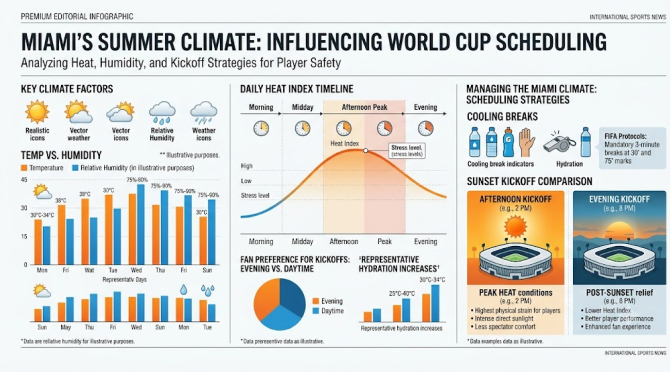
The heat index, which combines temperature and humidity, often becomes more relevant than temperature alone. In Miami Gardens, relative humidity levels frequently exceed 70 percent during June and July, creating conditions where perceived heat intensity is significantly higher than the actual air temperature.
FIFA’s medical protocols for major tournaments include mandatory cooling breaks when environmental thresholds are met. These breaks are designed to reduce physiological strain, particularly during high-intensity phases of knockout-stage matches where pace and pressure increase.
Broadcast partners, including major international sports networks, also adapt scheduling to balance global viewership with player safety considerations. Evening kickoff times become more valuable in Miami compared to other U.S. venues with milder climates.
Local transportation and event logistics are directly affected as well. Stadium arrival windows shift later in the day, while fan movement patterns concentrate closer to sunset kickoffs. This creates a compressed but more intense matchday flow around Hard Rock Stadium.
For additional context on stadium infrastructure and event operations in South Florida, local venue management information is available through Hard Rock Stadium official event operations.
Fan Safety Protocols and On-Site Cooling Infrastructure
Fan safety strategies at Hard Rock Stadium extend beyond standard security and crowd management. Heat-specific planning plays a central role in how the venue prepares for World Cup crowds.
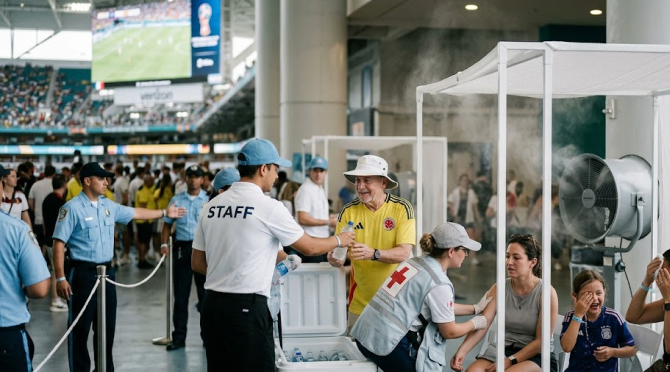
Medical teams are stationed throughout concourse levels and entry points, with rapid-response hydration and heat stress monitoring systems in place. Shade distribution zones, misting stations, and water access points are integrated into fan circulation design.
The stadium also adjusts concession layouts and entry timing to reduce crowd bottlenecks in exposed areas. This reduces the amount of time fans spend in direct sunlight before entering shaded seating zones.
The broader safety framework includes coordination between FIFA, Miami-Dade County emergency services, and stadium operators. Public advisories frequently recommend hydration planning, lightweight clothing, and early arrival adjustments for fans attending daytime matches.
Fan behavior patterns in Miami differ from other World Cup host cities due to climate intensity. Attendance flow tends to peak closer to kickoff for evening matches, while daytime fixtures generate more staggered arrivals and higher demand for shaded pre-entry zones.
A simplified breakdown of fan safety considerations at Hard Rock Stadium:
| Factor | Risk Condition | Operational Response |
|---|---|---|
| Heat Index Above 95°F | Heat stress risk increases | Cooling breaks + shaded zones |
| High Humidity | Reduced sweat evaporation | Hydration stations expanded |
| Midday Kickoff | Direct sun exposure | Scheduling preference shift |
| Large Crowd Density | Slower evacuation flow | Staggered entry timing |
Stadium Design and Miami’s Climate Reality
Hard Rock Stadium’s open-air design places greater emphasis on environmental adaptation compared to fully enclosed venues. While modern renovations have improved shading and airflow in seating sections, Miami’s tropical climate remains a defining factor in how events are experienced.
The stadium has previously hosted major international events, including Super Bowls and Copa América matches, which have provided operational lessons for managing heat-intensive conditions. Those experiences now feed directly into World Cup planning frameworks.
Cooling infrastructure is supplemented by strategic scheduling decisions. Evening kickoffs reduce solar exposure on seating areas and lower the risk of heat-related incidents. This approach aligns with global best practices for outdoor stadium events in tropical climates.
Fan distribution within the stadium is also influenced by shade mapping. Certain seating zones experience significantly lower direct sunlight exposure, which affects ticket demand patterns during high-heat fixtures.
Miami’s position as a global travel hub further intensifies matchday logistics. International fans arriving from cooler climates face additional adaptation challenges, increasing the importance of pre-event communication and safety guidance.
City-Wide Impact of Heat-Driven Scheduling Adjustments
Heat conditions do not only affect stadium operations. They influence transportation systems, hospitality demand, and public event planning across Miami-Dade County.
Transit systems adjust service frequency and timing to align with peak arrival and departure flows. Ride-share demand spikes closer to evening kickoffs, while midday movement patterns remain lower due to environmental discomfort.
Hospitality businesses near the stadium, particularly in Miami Gardens and nearby districts, adapt operating hours and staffing levels around match schedules. Cooling environments inside restaurants and bars become secondary viewing spaces for fans avoiding direct exposure.
Tourism activity also shifts in response to match timing. Visitors often plan daytime indoor activities and reserve stadium attendance for evening fixtures when conditions are more manageable.
For broader context on climate patterns influencing Florida events and seasonal safety considerations, the NOAA climate and weather resources provide official environmental data used in public planning and risk assessment.
Player Performance and Competitive Conditions Under Heat Stress
Heat affects not only spectators but also on-field performance. Players competing at Hard Rock Stadium must adjust hydration cycles, pacing strategies, and substitution timing based on environmental load.
High humidity reduces recovery speed between high-intensity runs, which can alter tactical execution. Teams often adopt more structured rotation patterns, especially in midfield roles where physical workload is highest.
Cooling breaks, now standard in FIFA tournaments under heat stress conditions, allow coaching staff to deliver tactical instructions while supporting physiological recovery.
The pace of matches in Miami can shift noticeably compared to cooler venues such as those on the West Coast or in northern U.S. cities. This environmental variance becomes part of competitive preparation throughout the tournament.
Medical staff monitor player biometrics continuously, including heart rate and hydration levels, to reduce risk during prolonged exposure. These systems reflect the increasing integration of sports science into major tournament operations.
Why Miami Becomes a Climate Test Case for World Cup 2026
Hard Rock Stadium represents one of the clearest examples of how climate shapes modern football tournaments. The intersection of global scheduling, broadcast demand, and environmental safety creates a complex operational environment.
Miami’s heat conditions force organizers to prioritize evening matches, expand cooling infrastructure, and refine fan safety protocols at scale. These adjustments influence not only local experiences but also broader tournament planning across other warm-weather host cities.
The World Cup 2026 schedule in Miami functions as a live case study in climate-adaptive sports management. Every match becomes part of a broader system balancing entertainment value with environmental realism.
As the tournament progresses, Miami’s role will continue to highlight how outdoor sporting events evolve in response to climate pressure, especially in regions where humidity and heat remain defining seasonal factors.