

Los Angeles was preparing for the inaugural LA Jazz Festival to become one of the city’s largest new cultural events of 2026, with a planned 17-day program running from August 7 through August 23 and a projected audience of roughly 250,000 people. Instead, organizers announced on August 7 that the festival would be postponed until 2027, citing unexpected public-safety and municipal costs connected to final permitting for the Dockweiler Beach portion of the event. The decision came just as the festival was scheduled to begin, leaving artists, vendors, ticket holders and local businesses dealing with a sudden change in plans.
The cancellation is significant because the festival was designed to be much more than a conventional concert. Its original plan combined free concerts in parks, late-night performances, a youth jazz camp, a statewide jazz conference, a Caribbean street carnival and a major ticketed beach finale featuring John Legend, Janelle Monáe, Raphael Saadiq, Charlie Wilson and Parliament Funkadelic featuring George Clinton. The scale of the proposed operation illustrates the growing challenge of transforming Los Angeles beaches and public spaces into temporary large-capacity entertainment venues.
For California’s event industry, the episode also raises a broader question: how much does it actually cost to turn a public beach into a major festival site?
Dockweiler Beach Was The Festival’s Most Ambitious Venue
Dockweiler Beach was intended to serve as the centerpiece of the festival’s final weekend. Located in Playa del Rey along Vista del Mar, the beach offers approximately three miles of shoreline, alongside recreational infrastructure including bike paths, picnic areas, fire rings, volleyball facilities and an RV campground. Its scale makes it an attractive public destination, but a large concert introduces requirements that are fundamentally different from ordinary beach recreation.
The planned Jazz on the Beach finale was scheduled for August 22 and 23. The Saturday lineup included Janelle Monáe, Charlie Wilson, Parliament Funkadelic featuring George Clinton, Big Freedia, Free Nationals & Friends, Nubya Garcia and Poncho Sanchez. Sunday’s program was scheduled to feature John Legend, Raphael Saadiq, Original Koffee, Ezra Collective, Terrace Martin and additional performers.
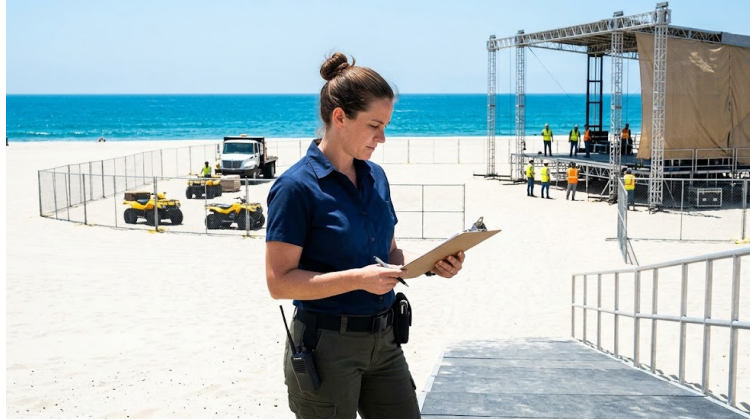
The event’s original promotional material described the festival as a 17-day celebration involving 150-plus artists and more than 50 events, while other promotional materials projected 250,000 attendees and more than 175 free concerts. Those figures demonstrate why Dockweiler was not simply being treated as a concert location. It was effectively being converted into a temporary entertainment district capable of handling a substantial influx of visitors.
That transformation requires far more than installing a stage.
The Original Festival Was Built Around Public Access
One of the most distinctive elements of the LA Jazz Festival was its attempt to combine large-scale entertainment with free community programming.
The City of Los Angeles announced the festival in February as the city’s first-ever Los Angeles Jazz Festival, highlighting plans for free music in public spaces across the city’s 15 council districts. The city also stated that approximately 75% of the festival’s tickets would be free, with charges primarily associated with the final Dockweiler Beach performances.
That model created an unusual economic structure.
Instead of relying entirely on ticket revenue, the festival was designed to spread its cultural footprint across neighborhoods and public parks. The official location list included Leimert Park, Hermon Park, Magic Johnson Park, Ted Watkins Memorial Park, North Hollywood Park, Point Fermin Park, Lake Balboa, MacArthur Park, South Park and numerous other locations.
The approach had clear community ambitions. It also created a complicated logistical network.
Each public location can involve different operating conditions, access requirements, neighborhood considerations and municipal coordination. The Dockweiler finale then added the largest concentration of spectators and the most complex temporary infrastructure requirements.
That meant the most visible part of the festival was also the component carrying the greatest operational risk.
A 250,000-Person Projection Changes The Equation
Large attendance projections can be useful for attracting sponsors and demonstrating economic potential, but they also influence how authorities evaluate safety.
An event expecting tens of thousands of people has fundamentally different requirements from a small beach concert.
Emergency planners need to consider how attendees arrive, where they park, how pedestrians move, how quickly emergency vehicles can reach an incident and what happens if an evacuation becomes necessary. Coastal venues add another layer because the available space can be geographically constrained by the ocean, roads and surrounding development.
The LA Jazz Festival’s own promotional material emphasized a citywide scale, with events running for more than two weeks and reaching multiple communities.
The economic opportunity was therefore substantial, but so was the potential municipal burden.
This is where the cancellation becomes more than a story about one festival.
It illustrates the financial tension between large-scale cultural programming and the public infrastructure required to support it.
Artists And Vendors Were Already Preparing
The timing of the cancellation made the disruption particularly severe.
Martin Ludlow, the festival’s founder and CEO, announced the postponement on August 7, the day the inaugural program was scheduled to begin. According to reporting by the San Francisco Chronicle, some musicians had already traveled to Los Angeles or incurred expenses for flights, hotels, rehearsals and production. Bay Area musicians including Pete Escovedo and his sons Juan and Peter Michael Escovedo were among those affected.
That creates a second layer of economic consequences.
A major festival does not only involve the promoter and headline performers. It creates a temporary network of:
- Musicians, stage crews and production workers
- Hotels, restaurants and transportation providers
- Food vendors, merchandise sellers and security contractors
- Local event staff, technicians and hospitality workers
When an event disappears at the last minute, those businesses may have already committed resources.
The festival’s organizers said ticket holders would receive full refunds within 30 days, according to the San Francisco Chronicle. But refunds address only one part of the economic impact. A performer who has already flown across the country or a vendor who has purchased inventory may have costs that cannot easily be recovered.
Why Beach Festivals Become Expensive
A conventional concert venue already has permanent systems for entrances, crowd movement, bathrooms, electrical infrastructure, emergency access and security. A beach does not have the same purpose-built infrastructure.
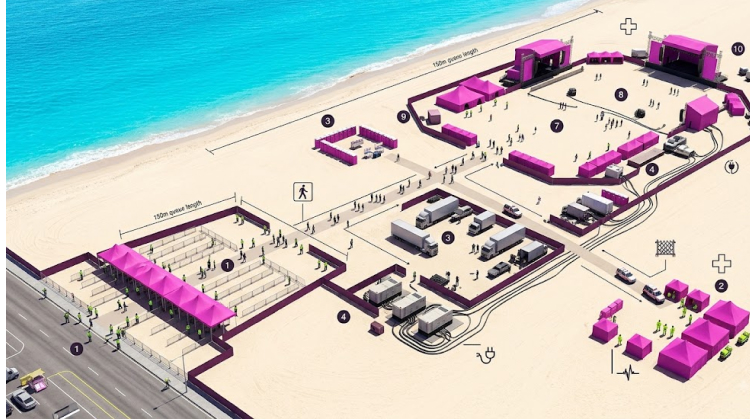
A large temporary event therefore has to build or supplement much of that system.
For a projected crowd approaching 250,000 over the entire festival period, organizers must account for multiple operational layers:
| Major Requirement | Why It Matters |
|---|---|
| Public safety personnel | Crowd control, emergency response and incident management |
| Medical operations | Treatment and emergency transport for attendees |
| Temporary infrastructure | Stages, fencing, lighting, power and sanitation |
| Traffic management | Vehicle access, parking, pedestrian movement and emergency routes |
| Permitting | Multiple agencies and regulatory requirements |
| Environmental protection | Managing a major event on a sensitive coastal site |
| Waste and sanitation | Handling large volumes of trash and wastewater |
| Security | Screening, restricted areas and protection of performers |
The festival’s organizers specifically cited unexpected public-safety and municipal costs associated with final permitting as the reason for postponing the 2026 event. That explanation points directly to one of the hardest parts of organizing large public events: costs can rise sharply during the final stages, when agencies determine the exact safety, traffic and municipal resources required.
The issue is particularly important in Los Angeles because beaches are public spaces with competing recreational, environmental and transportation demands.
Discover Los Angeles beach information
The Cancellation Followed Earlier Schedule Changes
The August 7 announcement did not occur in isolation.
The festival’s schedule had already undergone changes in the days leading up to the planned opening. According to reporting, organizers announced on July 31 that much of the programming was being consolidated around the Dockweiler Beach concerts. Some performers were also notified that portions of the festival had been postponed because of permitting and production issues.
Those changes matter because they show how a large festival can become increasingly dependent on its highest-profile component.
The original concept was geographically distributed. The festival website promoted events “on the beach, in the park, on the street, after dark,” with programming stretching across Southern California.
As the schedule changed, the Dockweiler component became increasingly central to the festival’s identity.
That increased the importance of successfully resolving the permitting and municipal requirements at the beach.
When that did not happen on the expected timetable, the entire 2026 festival became vulnerable.
Los Angeles Beaches Are Valuable Event Spaces
The attraction of Dockweiler is easy to understand.
The beach provides an expansive outdoor setting, proximity to Los Angeles International Airport and access to a major metropolitan population. Its location also gives promoters the opportunity to sell a fundamentally different experience from an indoor arena or traditional amphitheater.
But that appeal comes with a cost.
A beach is simultaneously a public recreational resource, an environmental setting and a transportation corridor. A large festival temporarily changes how all three functions operate.
Thousands of people arriving for a concert can affect parking patterns, pedestrian traffic and neighboring communities. Temporary fencing and staging can alter normal recreational access. Emergency personnel need routes through an area where visitors normally expect an open public environment.
The larger the festival becomes, the greater those pressures become.
That makes coastal event planning a balancing exercise rather than simply a question of whether a venue has enough physical space.
The Festival’s Cultural Ambition Was Significant
Despite the operational problems, the proposed LA Jazz Festival represented an ambitious attempt to connect Los Angeles’ music history with a modern citywide event.
The festival’s programming emphasized the city’s Black music history and included venues in communities with deep connections to jazz, soul, funk and related musical traditions. The planned lineup also crossed generations and genres, from John Legend and Janelle Monáe to George Clinton, Raphael Saadiq, Charlie Wilson and younger international performers.
That cultural positioning is relevant to understanding why the event attracted attention before it was postponed.
Los Angeles has a long association with jazz and Black music, particularly around historic areas such as Central Avenue and Leimert Park. A citywide festival could potentially have turned that history into a recurring tourism and cultural product.
The cancellation therefore creates an opportunity and a warning at the same time.
If organizers return in 2027, they will have to preserve the festival’s community ambitions while creating a much more predictable operational structure.
A 2027 Return Will Require A Different Approach
Organizers have said they intend to bring the festival back in 2027. That creates a year-long window to address the problems that prevented the inaugural event from proceeding.
The most important changes are likely to involve earlier coordination between organizers, municipal agencies, public-safety departments, transportation authorities and the operators responsible for temporary infrastructure.
A stronger planning model could also separate the festival’s programming into components with different levels of operational risk.
Free neighborhood concerts do not carry the same logistical demands as a 100,000-person beach finale. Treating them as distinct event categories could make it easier to protect the festival’s community programming if the largest venue encounters problems.
The Dockweiler concept itself may also require a more detailed capacity and cost model.
Instead of beginning with the desired lineup and projected attendance, organizers may need to establish the maximum practical capacity, municipal requirements and full public-safety costs first. The entertainment package could then be built around those constraints.
That would reverse the order that often creates problems for major events: promising a large experience first and resolving the infrastructure requirements later.
What The LA Jazz Festival Cancellation Means For California Events
The LA Jazz Festival’s postponement is a useful case study for California’s growing event economy.
The state has no shortage of attractive outdoor venues. Beaches, parks, waterfronts and public plazas provide settings that can make an event distinctive and potentially draw visitors from outside the region.
But those spaces are not empty event shells.
They already serve residents, recreational users and surrounding communities. Turning them into temporary high-capacity venues requires significant coordination, and the final cost can be much greater than the cost of booking artists and building a stage.
For Los Angeles, the lesson is especially relevant as the city continues preparing for an era of increasingly large international events.
The city’s ability to host major gatherings will depend partly on whether promoters and public agencies can create predictable systems for permitting, safety, transportation and public-space management.
The LA Jazz Festival was supposed to showcase what Los Angeles could do with a citywide cultural event. Instead, its last-minute postponement has highlighted the less glamorous side of event production: public safety, municipal coordination and infrastructure can determine whether a festival reaches the stage at all.
For Dockweiler Beach, the question is no longer whether the location can host a major concert. It is whether the financial and operational model can support one at the scale originally envisioned.
And for Los Angeles, the answer could influence how future festivals approach the city’s beaches, parks and other public spaces long before the first performer walks onto a stage.