California has approved a major new offshore aquaculture project that could transform a section of the Santa Barbara Channel into what would become the largest kelp farm in the United States. The decision comes as California continues to see regulatory developments across several industries, including California sports betting legal updates, while the state also weighs how new ocean-based industries can coexist with fishing, wildlife and coastal communities.
The California Coastal Commission voted unanimously on Wednesday, September 9, 2026, to allow Ocean Rainforest Inc. to move forward with its commercial-scale giant kelp operation in federal waters roughly six miles off the Southern California coast. The project will be built in phases across approximately 2,000 acres, or about 3 square miles, with the company projecting production of up to 6,000 tons of kelp annually once operating at full capacity.
The kelp will be cultivated offshore and eventually brought to Ventura Harbor, where it is expected to be processed into agricultural products, including biostimulants intended to reduce reliance on conventional fertilizers.
Construction could begin in 2027, but the approval does not mean the entire 2,000-acre operation will appear offshore immediately. The commission attached conditions requiring a phased buildout, periodic reviews and additional oversight as Ocean Rainforest expands the facility.
The decision places California at the center of a growing debate about offshore aquaculture: how much food and agricultural material can be produced in the ocean without creating unacceptable conflicts with commercial fishing, marine wildlife and other ocean users?
A 2,000-Acre Kelp Farm Will Rise Offshore Of Ventura
The project is substantially larger than Ocean Rainforest’s earlier demonstration operation.
The company has proposed cultivating native giant kelp, Macrocystis pyrifera, in a roughly 2,000-acre area of federal waters in the Santa Barbara Channel. Pacific Fishery Management Council documents describe the project as a phased commercial buildout located approximately 6.3 miles from Ventura Harbor. Cultivation units will use submerged grow lines, with kelp harvested at sea before being transported to Ventura for handling and processing.
The location matters.
The Santa Barbara Channel is already a heavily used marine environment. Commercial fishing, recreational fishing, shipping, marine research, wildlife conservation and other activities compete for ocean space. Establishing a 2,000-acre aquaculture operation therefore creates a different type of infrastructure project than a traditional farm.
There will be no fields, barns or irrigation canals visible from Ventura.
Instead, the production system will exist beneath the ocean surface, supported by moorings, cultivation structures and submerged lines.
| Project Detail | Current Plan |
|---|---|
| Developer | Ocean Rainforest Inc. |
| Crop | Giant kelp (Macrocystis pyrifera) |
| Location | Federal waters in the Santa Barbara Channel |
| Approximate size | 2,000 acres / roughly 3 square miles |
| Distance | About 6 miles offshore |
| Processing location | Ventura Harbor |
| Potential annual production | Up to 6,000 tons |
| Expected construction start | 2027 |
| Development approach | Phased buildout |
The project has been under development for several years. Ocean Rainforest previously operated an 86-acre pilot facility offshore of Santa Barbara to test whether giant kelp could be cultivated successfully in open-ocean conditions.
That earlier experiment is important because the commercial farm is not simply an untested concept being placed directly into the ocean.
Ocean Rainforest Already Tested Offshore Kelp Production
Ocean Rainforest began its California operations in 2020, establishing a U.S. base in Santa Barbara and working through a U.S. Department of Energy ARPA-E program focused on developing offshore macroalgae cultivation technology.
The company subsequently deployed its 86-acre demonstration project several miles offshore from Santa Barbara.
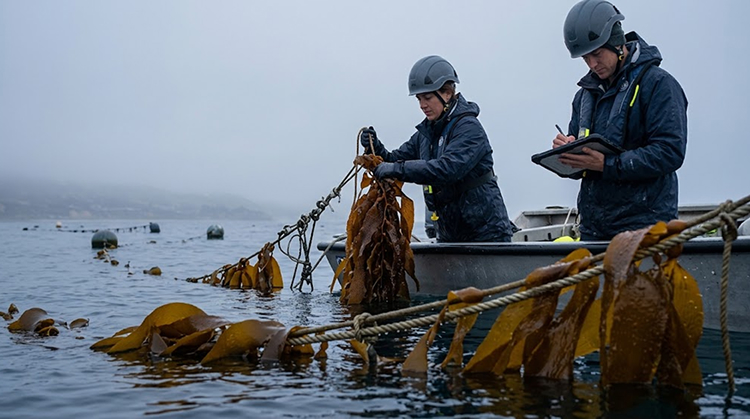
That pilot was intended to answer practical questions that conventional kelp farming cannot address. Giant kelp naturally grows in California waters, but cultivating it offshore requires equipment capable of surviving waves, currents, storms and biological stresses while remaining stable enough to support commercial harvesting.
A recent University of California, Santa Barbara-linked study also examined the use of side-scan sonar to measure kelp biomass on offshore aquaculture installations, using observations from an Ocean Rainforest installation offshore of Santa Barbara. Researchers found that acoustic technology could help estimate kelp height and biomass over large cultivation areas while reducing the labor involved in conventional monitoring.
That research illustrates one of the less visible aspects of the project: commercial kelp farming at this scale is as much a technology experiment as an agricultural one.
The company has to know how much kelp is growing, where it is growing, how much biomass can be harvested and whether the cultivation structures remain intact.
Ocean Rainforest says its earlier work helped provide the information needed to pursue commercial-scale production. Its U.S. operations are based in the Santa Barbara area, while the proposed commercial project is oriented toward Ventura Harbor.
Ventura Could Become The Processing Hub For A New Industry
The economic argument for the project extends well beyond the water.
Ocean Rainforest plans to bring harvested kelp into Ventura Harbor, turning the port into the operational center for a new form of marine agriculture.
Ventura is already closely connected to agriculture. The surrounding region produces strawberries, avocados and other crops, creating a potential local market for kelp-derived agricultural products.
Ocean Rainforest has proposed processing the giant kelp into a biostimulant that could be used by farmers. The company’s previous estimates presented to the Ventura Port District projected an economic impact of roughly $30 million to $50 million for Ventura County through cultivation, harvesting, processing and sales.
The potential connection between ocean farming and land-based agriculture is one of the project’s most distinctive characteristics.
Instead of harvesting kelp primarily as a food product for consumers, the proposed operation is oriented heavily toward agricultural applications.
Ted Travers, chief operating officer of Ventura County avocado grower Simpatica, has supported the concept, telling commissioners that agricultural kelp products could provide a locally produced alternative to material currently imported from the Atlantic region.
That could create a new supply chain connecting offshore cultivation, Ventura Harbor, agricultural processing and California farms.
For Ventura, the opportunity is also about diversification.
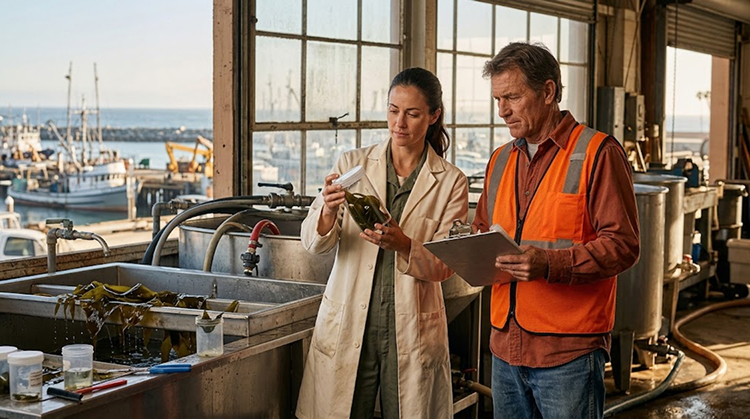
The port already supports commercial fishing and maritime activities. Adding aquaculture could create another revenue stream without requiring the construction of a large industrial facility along the city’s coastline.
California Wants Kelp But Is Also Trying To Protect Its Kelp Forests
The approval arrives at an interesting moment for California’s relationship with kelp.
The state is simultaneously trying to protect and restore native kelp ecosystems.
The California Department of Fish and Wildlife is developing a statewide Kelp Restoration and Management Plan covering both giant kelp and bull kelp. The strategy is intended to establish an ecosystem-based management framework, improve restoration efforts and create a more climate-ready approach to managing kelp forests.
California’s natural kelp forests provide habitat for fish, invertebrates and other marine species.
The giant kelp proposed for commercial cultivation is itself a native California species. The distinction between a managed aquaculture crop and a natural kelp forest is therefore important.
A commercial farm is deliberately structured, harvested and monitored. A natural kelp forest is a functioning ecosystem with its own cycles of growth, reproduction, disturbance and recovery.
The project could create some environmental benefits while also introducing new infrastructure into that ecosystem.
That is why the approval includes monitoring and phased development rather than simply allowing the full 2,000 acres to be built at once.
The California Department of Fish and Wildlife kelp program provides broader information about the state’s kelp ecosystems, commercial harvesting rules and restoration work.
Commercial Fishermen Will Lose Some Ocean Space
The most significant criticism of the project comes from people who already work in the Santa Barbara Channel.
A 2,000-acre farm inevitably occupies ocean space that cannot be used in exactly the same way as open water.
Commercial fishing groups have raised concerns about the cumulative effect of aquaculture and other activities on available fishing grounds. Pacific Fishery Management Council documents show that the proposed project has been subject to detailed consideration of fishing conflicts and mitigation measures.
The California Coastal Commission acknowledged that some commercial fishing would be displaced.
Ocean Rainforest and fishermen have been working on an industry support fund as part of the broader effort to address the conflict. The commission’s decision also requires the project to proceed in phases, giving regulators opportunities to evaluate how the operation affects marine users before allowing expansion.
That phased structure could prove critical.
A commercial farm of this size changes how vessels move through a section of the Santa Barbara Channel. Even if the actual cultivation lines remain submerged, fishermen must know where the infrastructure is located and what equipment is safe to use around it.
The conflict is therefore less about whether kelp itself belongs in California waters and more about how competing ocean uses can coexist.
The Project Has Already Faced A Lesson In Marine Infrastructure
There is another important part of the Ocean Rainforest story that received less attention than the commercial approval.
The company’s earlier pilot facility encountered problems during decommissioning.
The California Coastal Commission reopened the company’s 2021 consistency certification in July after two anchor sets from the demonstration project remained on the seafloor after the facility was removed. The pilot’s grow lines, buoys, moorings and other equipment were removed, but two anchor sets proved difficult to recover.
The issue mattered because the original approval required complete removal of the temporary facility.
The remaining anchors could interfere with bottom-contact fishing gear and created a conflict with commercial fishing in an area that had previously been available for fishing.
The commission authorized a remedial approach involving local fishermen. Ocean Rainforest agreed to fund efforts to recover the anchors or, if recovery proved impossible, support removal of other marine debris that creates hazards for fishing in the Santa Barbara Channel.
The episode provides a useful warning for the much larger commercial farm.
Offshore aquaculture equipment has to be designed for the full life cycle of the project, including installation, maintenance and eventual removal.
A structure that works during calm conditions may behave very differently after years of exposure to ocean forces.
Whale Protection Is A Major Environmental Question
Marine mammal protection has also been part of the debate.
Critics have raised concerns about the possibility of whales becoming entangled in kelp-farm infrastructure or being affected by additional vessel traffic.
Commission staff have emphasized that the proposed farm will use taut, rigid lines, rather than loose fishing lines that are associated with many entanglement risks. The facility will also be positioned farther offshore, where officials said marine mammal density is lower than in some coastal areas.
That does not eliminate environmental risk.
Any large structure placed in the marine environment can affect how animals move through an area. Monitoring will therefore be important as the farm expands.
There is also a potential ecological upside.
Kelp can create habitat and attract marine organisms, potentially increasing biological activity around cultivation structures. At the same time, changes in fish distribution could create new interactions between aquaculture and recreational or commercial fishing.
The project’s phased approach gives regulators an opportunity to examine those effects rather than assuming the full-scale farm will behave exactly like the smaller pilot.
Why Giant Kelp Could Matter To California Agriculture
The agricultural argument behind the project is unusual because kelp connects two sectors that are normally treated separately.
California agriculture depends heavily on fertilizers and other soil inputs. Kelp-derived biostimulants are being studied and marketed as products that can influence plant growth and potentially reduce the amount of conventional fertilizer required.
Ocean Rainforest’s proposed business model is built around that connection.
The company would grow the raw material offshore, harvest it at sea, bring it into Ventura Harbor and process it for agricultural applications.
That means a California farm could eventually use a product originating only a few miles from the state’s coastline rather than relying on a long-distance supply chain.
The environmental benefit will depend on the full production cycle.
If cultivation, harvesting, processing and transportation require substantial energy or generate other environmental costs, the advantages become more complicated. If the system can operate efficiently and provide useful agricultural products with relatively low resource inputs, the model becomes more compelling.
That is one reason the commercial project will be watched beyond Ventura.
Construction Could Begin In 2027
The September 9 vote does not mean construction starts immediately.
Ocean Rainforest expects construction could begin in 2027, with the farm initially occupying a smaller area before expanding through later phases. The California Coastal Commission and the U.S. Army Corps of Engineers will have continuing oversight as the project progresses.
That timeline gives regulators, fishermen, environmental organizations and Ventura officials additional opportunities to assess the operation.
The first stage will effectively become another test.
If the equipment performs as expected, kelp grows at commercially viable rates and environmental impacts remain within the approved limits, the farm can move toward its larger footprint.
If problems emerge, the phased approval provides mechanisms for additional review.
For an industry that remains relatively new in the United States, that incremental approach may be as important as the size of the final project.
California Is Testing A New Kind Of Coastal Industry
The Ocean Rainforest approval is significant because California is effectively testing whether large-scale marine agriculture can coexist with one of the country’s busiest and most environmentally sensitive coastlines.
The project combines several competing priorities.
It could create a new agricultural supply chain, diversify Ventura Harbor, support aquaculture jobs and produce a renewable biological resource.
It will also occupy commercial fishing grounds, require permanent offshore infrastructure and demand continued monitoring of marine wildlife.
California’s decision therefore represents more than permission to grow kelp.
It is a test of whether the Pacific Ocean can become a productive agricultural space without repeating the conflicts that have accompanied other forms of offshore development.
The experience of Ocean Rainforest’s earlier pilot has already shown that even a much smaller operation can create unexpected challenges, from anchor recovery to fishing access. The new commercial farm will be roughly 20 times larger than the original 86-acre pilot area, making the lessons from that demonstration especially relevant.
For Ventura, the next phase will happen largely out of sight beneath the Pacific surface.
For California, the implications could reach much farther: from commercial fishing and marine conservation to agriculture, port economics and the future of offshore aquaculture along the state’s coast.