

Let’s cut through the Instagram haze. What makes a route legendary? It’s not just the view.
True mountain biking is about switchbacks and shale. It’s a brutal elegance that needs commitment, not just a camera.
Downieville is a Gold Rush town turned mountain biking mecca. Riders tackle a 5,000-foot vertical drop in one afternoon. Trails like Sunrise and Butcher Ranch combine for a relentless test.
This isn’t just scenery. It’s a historical document. We’re diving into California’s riding culture, starting with Downieville.
We’ll look at the terrain, shuttle logistics, and gear needs. Think of this as your guide to California’s mountain biking. From Sierra epics to the coastal flow trails of Santa Cruz.
The real California experience isn’t on a postcard. It’s earned on treacherous, glorious descents.
Northern California Classic Trails
Northern California’s MTB trails California are like epic stories, with beginnings marked by gold rush dust. This area is bold, not subtle. It’s a place where trails are the stars, and riders are just along for the ride.
The Downieville Downhill is a highlight. Imagine it as a four-act play filled with dirt, stone, and excitement. You start at the top, ready to dive into the action.
- Act I: Sunrise Trail. This part is smooth, like a warm-up. It’s a chance to get your flow before things get tough.
- Act II: Butcher Ranch. Now, the trail gets technical. It’s like a rock quarry exploded here. This is where you earn your stripes, with challenging climbs and descents.
- Act III: Third Divide. The pace picks up here. It’s a fast, thrilling ride. Trees blur, and your grin grows wide.
- Act IV: First Divide. The final act is intense. The trail hugs the mountain, demanding your full focus. One mistake could be a long fall. It’s a ride that makes you pray.
Getting to Downieville is part of the adventure. Shuttles are essential for a full experience. In town, you can rent high-quality bikes for tackling the trails.
What you bring is key. A flat here means a long, challenging fix with no phone signal. Pack a strong repair kit, water, and be ready for anything.
Learning the terrain is essential. Know the difference between the fun Third Divide and the scary First Divide. Each turn tells a part of the trail’s story. Listen closely.
These MTB trails California are more than rides. They’re tests of endurance and skill, written in the earth itself. You don’t conquer them; you learn to speak their language, one thrilling ride at a time.
Southern California Desert Trails
Northern California’s trails are like a long, challenging opera. Southern California’s desert trails are more like a quick, precise jazz tune. You trade tall mountains for wide open spaces, and tough climbs for tricky turns.
Our bike trail reviews in this area focus on precision. It’s not about how long you can ride down. It’s about how well you can navigate. Every rock and every patch of dust is a puzzle to solve.
What makes desert riding special? First, you learn to read the ground. The fine dust tells you how slippery it is. Too much dust means you might slide out.
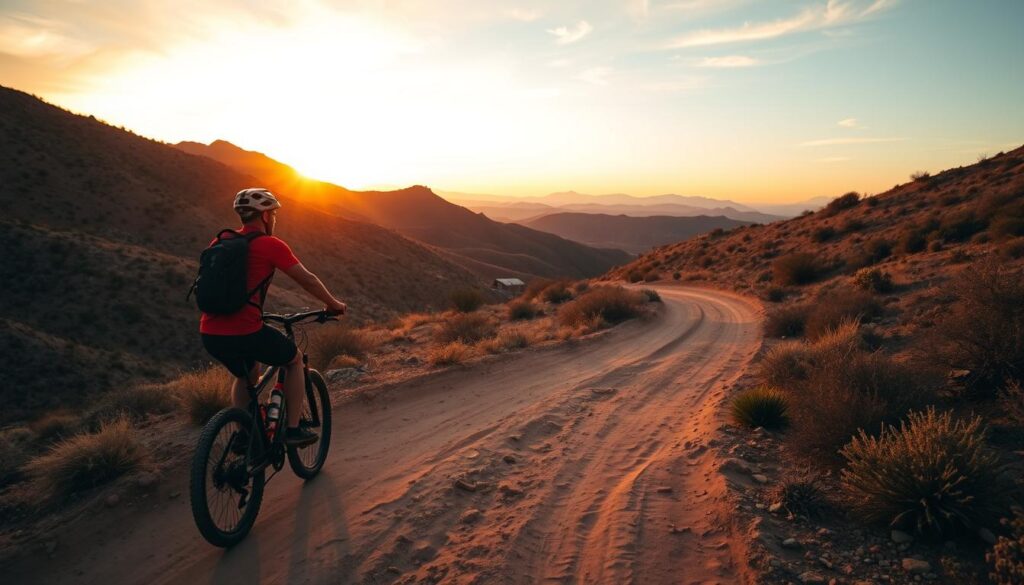
Second, finding shade is key. A lone tree or rock is more than just a pretty view. It’s a place to cool off. You plan your rides around these spots like a general plans a battle.
The trails have a simple beauty. They cut through scrub with straight lines. There’s no hiding bad design under trees. Every turn and bump is clear under the sun.
| Characteristic | Desert Trails | Forest Trails |
|---|---|---|
| Surface Conditions | Dust, sand, hardpack, loose rock | Soil, roots, mud, pine needles |
| Technical Focus | Precision handling, traction reading | Endurance, line choice through obstacles |
| Climate Strategy | Heat management, shade as resource | Rain preparation, temperature layers |
| Visual Aesthetics | Minimalist, exposed, geometric lines | Canopied, organic, hidden features |
| Riding Rhythm | Explosive sprints, technical bursts | Sustained flow, marathon pacing |
Desert trails offer a different kind of ride. They demand quick, precise moves. It’s like doing many short sprints, not one long run.
The challenges are more about thinking than just riding. You need to figure out the best path, considering dust and heat. What looks easy at first can become very hard as the sun gets stronger.
Bike trail reviews are very helpful here. A trail might be easy in spring but hard in summer. Our reviews help you know what to expect, no matter the season.
Places like Gooseberry Mesa in California show this. Trails like “The Gorge” require perfect balance and control. It’s all about finesse, not brute force.
Wildlife interactions change too. You might see lizards and snakes instead of deer. You need to be careful not to disturb the desert’s delicate balance.
Desert riding is for those who love solving problems while riding. It’s about mastering technical sections, not just going fast. The joy comes from overcoming challenges, not just surviving a long ride.
For those who enjoy this kind of challenge, good bike trail reviews for Southern California desert trails are key. They should highlight the technical skills needed, how the trail changes with the seasons, and the unique beauty of each ride.
Technical vs Flow Trail Preferences
Forget Myers-Briggs; the true measure of a rider’s soul is whether they seek the punishing puzzle of technical terrain or the euphoric rush of a flow trail. This isn’t about geography anymore. It’s psychology.
This preference reveals a fundamental schism in California mountain biking culture. Are you a thinker or a feeler? Do you worship at the altar of calculated precision, or do you pray to the god of momentum?
The technical trail is the quintessential California mountain biking crucible. It’s the Sage’s path. Here, gravity isn’t a force; it’s a petty bureaucrat with a rulebook. Your ride becomes a slow, cerebral game of chess against granite and roots.
Success demands patience, micro-adjustments, and a deep respect for physics’ cruel jokes. The skills it forges are problem-solving under pressure, flawless bike-body separation, and tactical line choice. It’s less about speed and more about the quiet victory of cleaning a section you walked last month.
Conversely, the flow trail represents a different California mountain biking ideal. It’s the liberated id on two wheels. This is kinetic poetry, a reward for fitness and bravery where the bike becomes an extension of your will.
The goal is rhythm, not riddles. You pump, carve, and float with the terrain. The skills it develops are commitment, reading the trail ahead at speed, and finding the pump in every transition. It’s visceral, euphoric, and deeply addictive.
Your choice in California mountain biking is a Rorschach test. The technical rider often posts about flow’s freedom but secretly craves the puzzle. The flow devotee might boast of conquering rock gardens but lives for the berms.
Which one do you actually prefer? Listen to your internal monologue. On a technical climb, are you swearing or solving? On a flow descent, are you calculating or carving?
So, which path calls to you in California mountain biking? The sage’s deliberate puzzle or the id’s liberated dance? Your answer defines your ride. It might even define your weekend.
Embrace your true preference. It leads to the purest form of California mountain biking joy—the kind that doesn’t need a filter.
Bike Park vs Natural Trail Experiences
Bike parks offer the chance to repeat rides, while natural trails bring the thrill of the unknown. These are two different ways to enjoy MTB trails California.
Imagine it like movies versus documentaries. Bike parks are like action movies, full of excitement and safety. Natural trails are like documentaries, full of surprises and sometimes requiring patience.
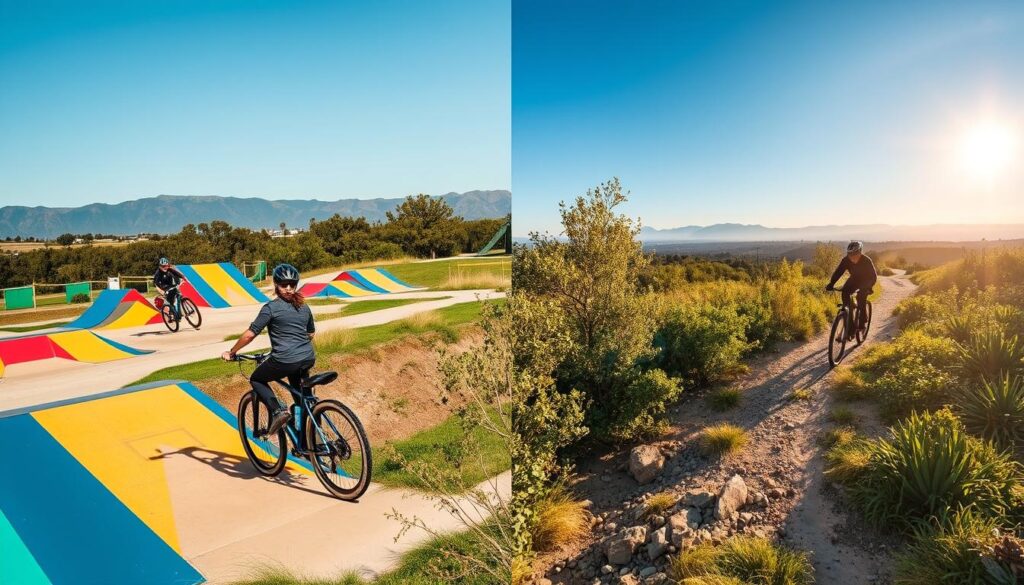
Mammoth Bike Park is a great example of a bike park. Their FAQ is like a guide for adults. They require a full-face helmet and knee/elbow pads for safety. The trails are designed carefully, from easy to challenging.
At Mammoth, your bike choice is important. They offer downhill and enduro bikes for experts. They also have rules for eMTBs and adaptive bikes. Plus, they offer repair services and help you plan the longest ride.
The experience at bike parks is engineered. You ride up, then down, again and again. This helps you improve your skills on known features.
On the other hand, natural trails in the Sierra Nevada are different. There’s no guide, and you need to bring your own gear. Your bike choice depends on how far you’re willing to carry it. The trails are not marked, but you earn your way through them.
Here’s a key comparison:
- Bike Park: Lift-access luxury, groomed features, clear progression, mandatory safety gear, on-demand repairs, predictable conditions
- Natural Trail: Self-powered adventure, organic features, earned progression, personal responsibility, self-reliance, changing conditions
Which is better for learning? Bike parks give instant feedback on jumps and berms. Natural trails teach you to navigate and read the terrain. Which is more fun? Bike parks offer constant excitement. Natural trails give the joy of conquering the wild.
The answer is it depends. Do you want to improve specific skills? Bike parks are great. Looking for a wilderness experience? Natural MTB trails California are the only choice.
California offers both. You can practice jumps at a bike park and then explore the wilderness. Bike parks improve your skills. The wilderness tests your adaptability.
My advice? Use bike parks to sharpen your skills. Then, take those skills to natural trails for a real challenge. Bike parks teach you to ride features. The wilderness teaches you to ride mountains.
Every California mountain biker should try both. Bike parks for focused learning. Natural trails for real adventure. Together, they make a complete rider, ready for any MTB trails California.
Seasonal Trail Conditions Guide
The difference between a great ride and a bad one in California often depends on the season. Getting this wrong is a big mistake. It’s like wearing a swimsuit in a snowstorm or sunscreen in a monsoon.
California has three main weather patterns. Each area—desert, coast, and mountains—has its own harsh rules. Your vacation plans don’t matter to them.
In the desert, it’s like walking into a hot oven from June to September. The ground gets so hot it can burn you. But from October to April, the desert changes. The air cools, and the trails become perfect. This is when desert bike trail reviews turn positive.
The coast has its own challenges. “June gloom” is a thick fog that hides everything. But by late summer, the fog clears, and the weather is perfect. The trails dry out, and you enjoy the ride.
The mountains are the most unpredictable. The high Sierra doesn’t care about your plans. Snow can last into June. The best time is usually in July. By August, the Downieville Classic shows the trails are ready. Then, by October, snow starts to fall again.
Bike parks have their own schedule. They’re open from June to September, providing perfect conditions. This is different from natural trails.
So, how do you deal with these different areas? Follow this guide:
- Desert Season: October-April. Avoid summer unless you’re training for Dante’s Inferno.
- Coastal Windows: Late August-November. The fog lifts, the trails breathe.
- Alpine Access: July-September. Watch snow reports like a stock ticker.
- Bike Park Hours: June-September. They’re open when they’re open.
This isn’t just about comfort. It’s about taking care of the trails. Riding in wet conditions can damage the trails. Your timing affects the environment.
For more information, check out our ultimate guide to MTB trails in. It’s a great resource for planning your rides.
California mountain biking is more than just skill. It’s about timing and strategy. The desert, coast, and mountains won’t wait for you. You need to move between them to find the best conditions.
Mastering the calendar can make your bike trail reviews positive. Get it wrong, and you’ll learn the hard way. Trust me, I’ve been there.
Wildlife and Environmental Considerations
Forget conquering the landscape; the real challenge of California mountain biking is navigating it without leaving a trace or provoking a wildlife incident report. You’re not the main character here. You’re a guest in a biome that predates suspension forks by a few million years.
This isn’t just about avoiding snakes sunning on a fire road or giving a wide berth to a mountain lion’s territory. It’s intellectual respect. The Sage rider observes the system they’re bombing through.
Let’s talk teeth and claws first. California’s residents operate on simple logic. A rattlesnake isn’t aggressive; it’s defensive. Sudden, loud vibrations from your bike? That’s a threat. A mountain lion sees a solo rider as possible prey. The solution isn’t fear, it’s protocol.
Ride with a buddy. Make noise on blind corners. If you do encounter a big cat, do not run. Stop, make yourself look big, and back away slowly. It’s less a confrontation and more a recalibration of its risk assessment spreadsheet. You’re just convincing it you’re not an efficient calorie source.
Now, onto the less dramatic but more pervasive impact: your tires on the dirt. Trail erosion isn’t an abstract concept. It’s the direct result of braking skids, cutting switchbacks, and riding when the soil is saturated. Think of a wet trail as a sponge. Riding on it is like squeezing that sponge into a muddy, rutted mess.
This is why many trails legitimately close after rain. It’s not bureaucracy; it’s preservation. A closed trail sign is the land manager’s way of saying, “Let the sponge dry out, please.” Ignoring it doesn’t make you a rebel. It makes you a contributor to trail degradation.
Which brings us to the unspoken etiquette of yielding. The hierarchy is simple, yet often ignored. Uphill riders have the right of way. Why? Their momentum is harder to restart. A simple nod or a “thanks” as you pull aside isn’t just polite; it’s oil for the social machinery of the trail.
Hikers and equestrians always have priority. Your bike is a machine. You are the one with the greater ability to control and stop. Yielding is a non-negotiable act of shared-space diplomacy.
Ultimately, sustainable California mountain biking is a practice in humility. It asks you to see the trail not just as a challenge to be beaten, but as a fragile, living corridor. The goal shifts from personal bests to leaving the landscape as you found it—or better. The true mark of a rider isn’t just the descents they clean, but the fact that the trail remains rideable for the next person, and the wildlife remains undisturbed.
It’s the difference between being a tourist and being a steward. The land was here long before carbon fiber was invented. Our privilege is to ride it, not ruin it.
Trail Maintenance and Volunteer Opportunities
Trails don’t magically fix themselves. It takes passion, beer, and community effort to keep them in shape. Let’s explore who works to build and maintain these paths.
Finding perfect singletrack is just a dream. Every berm and technical feature on our MTB trails California comes from hours of work and funding. It’s like building infrastructure, but with better views.
The Downieville Classic is a prime example of trail economics. It’s not just a race; it funds the Sierra Buttes Trail Stewardship. Your entry fee helps create trails.
Events often fund trail networks. The money comes from us, the riders, not from grants. It’s a reality we need to face.
Trail stewards are nonprofits, clubs, and individuals working hard. Groups like the Sierra Buttes Trail Stewardship protect our trails. They handle permits and erosion control so we can ride.
Volunteering is more than charity. It’s a way to learn about trails. Grab a tool and help out to gain valuable knowledge.
Volunteering teaches you about trail design. You’ll understand why trails are built the way they are. This knowledge changes how you ride.
Regular volunteers get early access to new trails. They build relationships with land managers. It’s a way to be part of the trail-making process.
Volunteering is a civic duty. Without maintenance, trails disappear. Climate change and erosion threaten our MTB trails California. We need to act.
Getting involved is easy and rewarding. Most groups provide tools and drinks. You just need to show up and be willing to learn.
This is the real backbone of mountain biking. It’s the economy of dirt that keeps our trails alive. Ignore it, or better yet, join in and help build the future of MTB trails California.
Skills Progression and Trail Selection
Choosing the right trail is simple. Match your skills to the trail’s level. It’s not about showing off; it’s about enjoying the ride. A smart rider knows when to take on a challenge and when to back off.
Start with beginner trails, known as the “Discovery Zone.” These paths have wide turns and gentle slopes. They’re perfect for learning the basics. As you get better, move to trails that need more skill.
At this level, an enduro bike is your best friend. It can handle most trails. But remember, the right bike is key to a good ride.
Knowing when to use a downhill bike is important. Save it for expert trails at places like Mammoth Mountain. Bike trail reviews show that choosing the right bike is as important as choosing the right trail.
Use bike trail reviews to guide your progress. They help you find trails that are challenging but not too hard. Look for trails with technical features and climbs to see if they’re right for you.
Your ride should leave you feeling excited, not needing a rescue. Choose your trail wisely. This way, you’ll move from beginner trails to tackling tough trails with confidence.