
California’s first documented sea turtle nests have already become an extraordinary conservation story, but the next chapter began with an emergency. On September 25, biologists removed 204 olive ridley sea turtle eggs from two Orange County beaches after Hurricane Polo threatened to bring hazardous surf, erosion and flooding to the nesting sites.
The eggs were collected from Seal Beach and Huntington Beach, where olive ridley turtles made the first documented natural sea turtle nests on the U.S. West Coast. Rather than leave the eggs exposed to storm-driven waves, wildlife officials transferred them to the Aquarium of the Pacific in Long Beach, where they are being held in controlled conditions for the remainder of their incubation period.
The decision came only days after the nesting events themselves. A female olive ridley was first observed digging a nest near Seal Beach on September 16, while another turtle was documented nesting near the Huntington Beach Pier on September 19. NOAA Fisheries says this is the first recorded nesting of any sea turtle species on the U.S. West Coast. NOAA’s California olive ridley update documents the discovery and the emergency relocation.
Hurricane Polo Created A Narrow Window To Protect The Nests
The rescue was driven by a specific combination of coastal conditions rather than the presence of Hurricane Polo alone.
The storm was approaching the eastern Pacific while Orange County was also facing high astronomical tides and hazardous surf. Biologists determined that waves and coastal flooding could reach the nests and wash away the sand protecting the eggs.
That posed a direct threat because sea turtle eggs cannot simply be exposed to seawater and then returned to the nest. Once the eggs are removed, their position and orientation must be handled carefully so the developing embryos are not unnecessarily disturbed.
The Los Angeles Times reported that biologists from NOAA and the U.S. Fish and Wildlife Service worked at both nests during the early morning of September 25. The 204 eggs were placed into containers packed with sand, then transported to Long Beach while being handled as gently as possible.
The Aquarium of the Pacific had already been involved in sea turtle rehabilitation for decades, giving officials a facility equipped to provide controlled incubation.
The Aquarium of the Pacific conservation program now provides the temporary setting for an experiment that California has never conducted before: incubating naturally laid olive ridley eggs collected from a California beach and potentially returning the hatchlings to that same coastline.
The Eggs Came From Two Historic Orange County Nests
The two nests are significant because they represent something scientists had never documented on the American West Coast.
The first female appeared near Seal Beach on September 16. A beachgoer noticed the turtle digging and alerted Huntington Beach lifeguards, who helped initiate the response. Three days later, another nesting event occurred approximately eight miles away near Huntington Beach Pier. NOAA says photographs and physical characteristics indicated that the two observations involved separate turtles.
Olive ridleys are primarily associated with tropical and subtropical waters. Major nesting populations occur along Pacific coastlines farther south, including Mexico and Central America. The appearance of nesting females in Orange County therefore raises questions about why these particular turtles traveled so far north.
Scientists have not established a single explanation.
Jeffrey Seminoff, who leads NOAA’s marine turtle ecology and assessment work, has pointed to several possible factors, including unusually warm ocean conditions and the developing El Niño. Other possibilities include changing currents, prey distribution or simple navigational error. The available evidence does not establish that El Niño caused the nesting.
That distinction matters because two nesting events are enough to establish a remarkable observation, but not enough to demonstrate a permanent shift in the species’ geographic range.
The 204 Eggs Are Now In A Controlled Incubation Environment
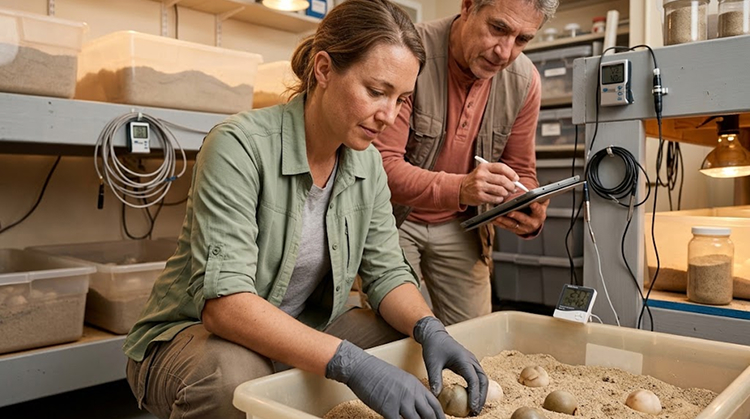
At the Aquarium of the Pacific, the eggs are being kept in sand-filled containers under controlled temperature and humidity conditions.
The incubation period for olive ridley eggs is generally around 45 to 60 days, although actual timing varies according to environmental conditions. The Aquarium says the California eggs will remain under staff care for that period before the hatchlings are released if the eggs successfully develop.
That creates an expected timeline extending into early November.
The facility’s goal is to replicate the conditions the eggs would have experienced underground while avoiding the immediate threats posed by storm waves and erosion. Staff will monitor the eggs without repeatedly disturbing them.
| California Olive Ridley Nest Rescue | Current Detail |
|---|---|
| First nest | Seal Beach, September 16, 2026 |
| Second nest | Huntington Beach, September 19, 2026 |
| Eggs recovered | 204 |
| Rescue date | September 25, 2026 |
| Temporary facility | Aquarium of the Pacific, Long Beach |
| Expected incubation | Approximately 45–60 days |
| Expected hatch period | Around early November |
| Planned release | Original nesting beaches, if successful |
The controlled environment does not guarantee that every egg will hatch. The viability of the eggs was not yet known when the rescue occurred, and natural incubation itself carries substantial biological uncertainty.
Scientists Plan To Return The Hatchlings To Southern California
If the eggs successfully hatch, the Aquarium of the Pacific plans to release the young turtles on the beaches where their mothers laid the eggs.
That detail is particularly important for conservation biology.
Sea turtle hatchlings normally emerge from a nest and immediately make their way across the beach toward the ocean. The journey exposes them to predators, artificial lighting, waves, people and other hazards. The movement from nest to water is part of their natural behavior and may also provide sensory information associated with their natal beach.
The Aquarium therefore does not intend to keep the hatchlings as permanent residents.
Instead, the plan is to give them the opportunity to make the final portion of their journey under natural conditions. Aquarium officials said the young turtles would be released as soon as possible after hatching so they can enter the Pacific with the energy supplied by their yolk reserves.
The strategy is consistent with the broader goal of treating the rescue as a temporary intervention rather than creating a captive population.
Olive Ridleys Face A Difficult Journey From Egg To Adult
The significance of the 204 eggs becomes clearer when considering how few sea turtle hatchlings survive to adulthood.
Olive ridleys are among the smaller sea turtle species, but their life cycle involves extensive migrations between nesting beaches and ocean habitats. Females can produce multiple clutches during a nesting season, while eggs remain vulnerable to flooding, erosion, predators and other threats.
U.S. Fish and Wildlife Service research identifies high tides and erosion as important sources of egg loss in olive ridley nests. The agency’s recovery material also notes that incubation generally takes roughly 50–60 days, with temperature, moisture and sand characteristics affecting development.
The California rescue therefore addresses one very specific threat: storm-driven destruction of the nest itself.
It does not remove the natural risks that come after hatching.
Once the turtles reach the ocean, they will face predators and the challenges of surviving in an enormous marine environment. The fact that the eggs receive human protection during incubation does not mean the resulting hatchlings will have an unusually easy path to adulthood.
That is why biologists are treating the event as a conservation opportunity rather than assuming that a successful hatch will establish a new California population.
Southern California’s Coast Was Already Changing Before The Turtles Arrived
The nesting events also occurred during an unusual period for Southern California’s marine environment.
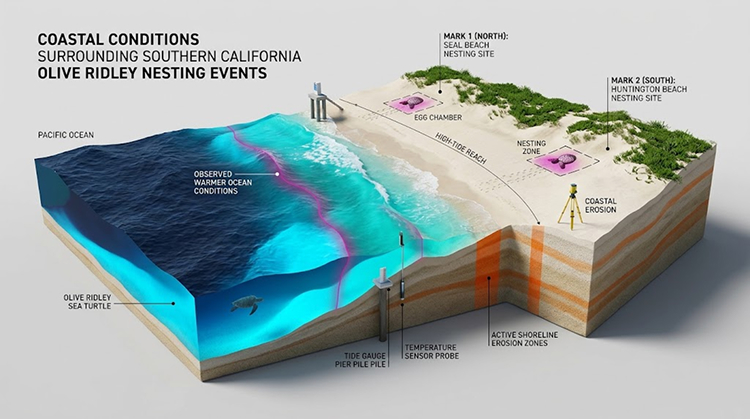
Ocean temperatures have been elevated, while a strong El Niño has developed across the equatorial Pacific. At the same time, California beaches have experienced significant changes in wave conditions and coastal erosion.
Those factors provide plausible environmental context for the turtles’ appearance, but scientists have not determined whether they caused the nesting behavior.
The NOAA El Niño monitoring program continues to track the unusually warm Pacific conditions that could influence weather and ocean patterns during the 2026–27 season. The relationship between those conditions and olive ridley nesting in Orange County remains a subject for future research rather than an established cause.
The distinction is important because wildlife ranges naturally fluctuate.
A single unusual observation can be meaningful without proving that an ecosystem has permanently changed. Scientists will need additional observations, nesting attempts and environmental measurements to determine whether Southern California becomes a recurring nesting area.
More Olive Ridleys Could Still Appear On California Beaches
The story may not end with these two nests.
Aquarium of the Pacific officials have said additional olive ridleys could potentially nest on Southern California beaches. The nesting season is not necessarily over, and the appearance of two females within a few days demonstrates that suitable nesting behavior can occur much farther north than previously documented.
That possibility creates a new challenge for beach communities.
A nesting turtle can be difficult for an ordinary beach visitor to recognize, particularly at night. A female may emerge from the surf, crawl above the high-tide line and spend significant time digging before depositing her eggs.
The public should avoid approaching, touching or illuminating a turtle and should report a suspected nesting animal to appropriate wildlife or local authorities.
The U.S. Fish and Wildlife Service sea turtle guidance emphasizes the importance of giving nesting turtles space and reporting nesting activity rather than interfering with the animal.
That approach becomes especially important in Southern California, where beaches are heavily used by pedestrians, surfers, tourists and nighttime visitors.
Seal Beach And Huntington Beach Are Now Part Of A New Conservation Story
The locations of the two nests add another layer to the discovery.
The Seal Beach nest appeared near a heavily developed section of the Orange County coast, while the Huntington Beach nest was found near one of Southern California’s most recognizable public beaches. Neither location resembles the remote tropical nesting beaches most commonly associated with olive ridleys.
The contrast demonstrates how wildlife can occasionally use highly urbanized coastal environments.
Seal Beach already contains important protected habitat at the Seal Beach National Wildlife Refuge, a 965-acre wetland area within Naval Weapons Station Seal Beach. The refuge supports numerous protected species and migratory birds, although the refuge itself is generally closed to public access except for scheduled tours.
The olive ridley nest was not the same thing as evidence of a new established refuge population, but its proximity to other protected coastal habitat highlights the ecological value that remains within Southern California’s developed shoreline.
For Huntington Beach, the event demonstrates another challenge: protecting wildlife on a beach that is also heavily used for recreation, tourism and major public events.
The Hurricane Rescue Could Become A Blueprint For Future California Nests
The decision to relocate the eggs was unusual because the nests themselves were unprecedented.
Wildlife officials had to balance natural processes against a clear and immediate threat. Leaving the eggs in place would have allowed nature to determine the outcome, but forecast surf, flooding and erosion created a substantial possibility that the nests would be destroyed before incubation ended.
Moving the eggs created a controlled alternative.
That intervention could become useful if another olive ridley nests in California and faces similar conditions. It also gives biologists an opportunity to document incubation, hatching and release in a setting where temperature and humidity can be monitored closely.
The Aquarium of the Pacific has said its animal-care staff will continue working with federal wildlife agencies throughout the process. The institution’s existing experience with sea turtle rehabilitation gives researchers and conservation officials a local facility capable of responding quickly when unusual marine wildlife events occur.
CaliforniaTimes previously covered the historic Southern California olive ridley nesting that first brought these turtles into the state’s conservation spotlight. The new rescue adds a very different dimension: the question is no longer whether an olive ridley can nest here, but whether any of these unprecedented California eggs will successfully produce hatchlings.
Early November Could Bring California’s First Olive Ridley Hatchlings
The next major milestone is likely to come in early November, when the 45- to 60-day incubation period reaches its expected window.
There is no guarantee that all 204 eggs are viable or that every viable egg will hatch. The Aquarium and wildlife agencies will continue monitoring the nests under controlled conditions rather than repeatedly disturbing them to check development.
If hatchlings emerge, their release will become another unprecedented event for the California coast.
The young turtles would be returned to the beaches where the eggs were originally found and given the opportunity to cross the sand into the Pacific. That moment would connect an emergency conservation intervention directly back to the natural environment where the story began.
For now, the most significant fact is that two olive ridley females independently chose Southern California beaches in September 2026, something never previously documented on the U.S. West Coast.
Hurricane Polo transformed that discovery into an emergency within days. The 204 rescued eggs now sit at the Aquarium of the Pacific, where biologists are waiting to see whether California’s first documented olive ridley nests will produce the state’s first documented olive ridley hatchlings.